Gen Z Is Asking ChatGPT to Read Their Tarot Cards. Here's What Actually Gets Lost.
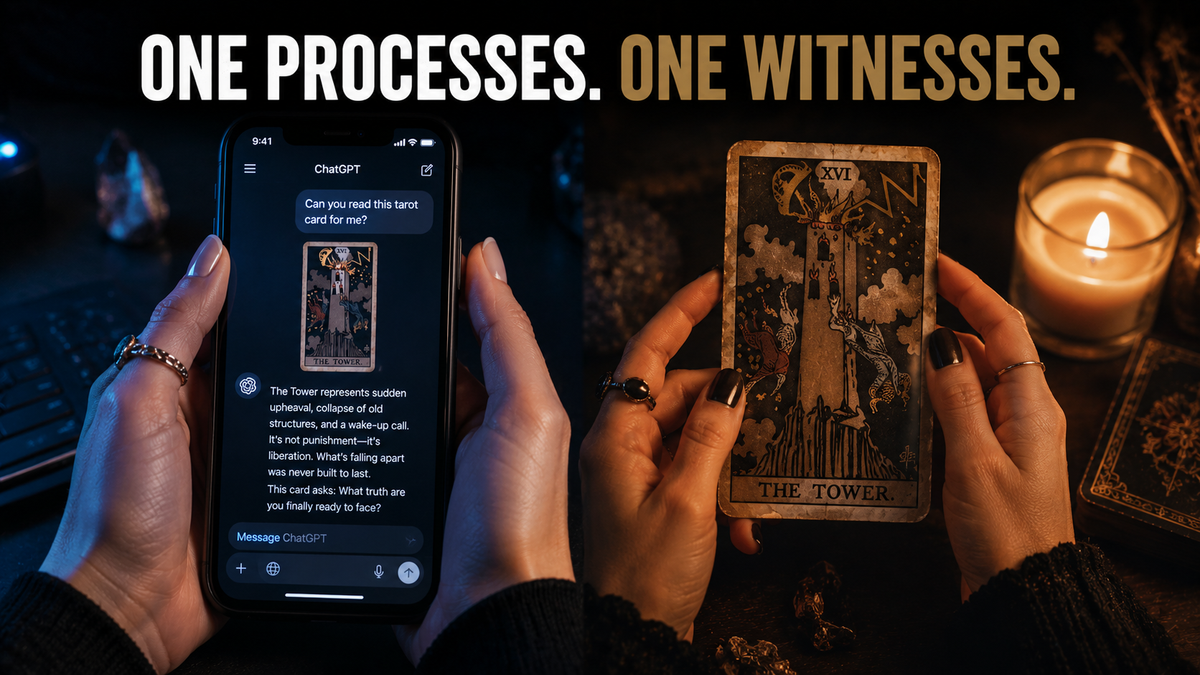
An AI can absolutely tell you what The Tower means. It cannot notice your hands shaking when it lands.
The Inner Rebel
An AI can absolutely tell you what The Tower means. It cannot notice your hands shaking when it lands.
It's a real and growing trend: people, disproportionately younger, asking AI chatbots to pull and interpret tarot cards for them, sometimes uploading a photo of a physical spread, sometimes just asking the bot to "draw" three digital cards and explain what they mean. Reporting on the trend frames it, accurately, as part of a broader pattern — a generation reaching for digital tools to process uncertainty, in a moment when professional mental health support is expensive, hard to access quickly, and often has a waitlist measured in months rather than minutes. An AI tarot reading is available at 2am, costs nothing, and never seems impatient. I understand completely why that's appealing. I also think something specific and important gets lost in the swap, and it's worth naming exactly what.
What an AI Can Actually Do Here
Give an AI model credit for what it genuinely can do well: it knows the traditional meanings of every card in the deck, can explain symbolism accurately, can hold a conversation that feels attentive, and can do all of this without judgment, financial pressure, or scheduling friction. For someone who just wants to understand what The Hanged Man traditionally represents, or who wants a low-stakes way to reflect on a decision at an hour when no human reader is available, that's a real, legitimate use, and I'm not interested in pretending otherwise to protect my own profession from a more convenient competitor.
What Actually Happens in a Human Reading That Doesn't Transfer
Here's the part that doesn't survive the swap, and it's not mystical, it's observational. A huge share of what makes a tarot reading land isn't the card. It's everything happening in the room around the card — the half-second pause before someone answers a question, the detail they mention twice without seeming to notice they did, the moment their voice changes when a card touches on something they hadn't planned to talk about. A human reader is building the actual reading out of that material as much as out of the seventy-eight possible cards, adjusting in real time to what's actually present in the person sitting across from them. An AI, no matter how sophisticated, is working from the text you type and nothing else — it cannot see your face change, cannot hear the catch in your voice, cannot notice that you've changed the subject away from your mother three times in ten minutes without seeming to register you're doing it.
The card was never the whole reading. The card was always just the excuse to pay close attention to a person. Remove the person paying attention, and you've kept the prop and lost the actual mechanism.
The Comfort of Something That Can't Judge You, and Its Cost
Part of the appeal, openly discussed by people using AI this way, is the total absence of judgment — no human face reacting, no fear of a reader's opinion, no social cost to saying the most embarrassing version of the truth. That comfort is real and shouldn't be dismissed. But the absence of a human witness also removes something that turns out to matter more than it sounds like it should: being believed, in real time, by another actual person, carries a weight that being processed by a system carries differently. Plenty of people describe AI conversations as helpful in the moment and strangely unsatisfying afterward, in a way they struggle to name — often, I'd argue, because some part of them correctly registers that no one actually witnessed what they just said. The relief of confession requires, structurally, someone else to have heard it. A system that generates a response is not quite the same category of event as a person who heard you.
Where This Is Probably Heading, and What I'd Actually Recommend
I don't think the answer is gatekeeping tarot away from AI tools, which would be both futile and a little precious. I think the more useful framing is matching the tool to the actual need: if what you need is information — what does this card traditionally mean, what's the symbolism here — an AI is a genuinely fine resource, available instantly, free of charge. If what you need is to be witnessed — to have another conscious person register, in real time, the actual weight of what you're carrying, and respond to you specifically rather than to a category of input — no model currently does that, and I'd be suspicious of any reader, human or otherwise, who claims they can manufacture that experience without an actual person on the other side of the table.
So: next time you're tempted to ask a chatbot to read your cards at 2am, ask yourself honestly which one you actually need tonight — information about what a symbol traditionally means, or a witness. Because only one of those is currently available from a machine.