Mysticism: True, False, or Are We Asking the Wrong Question?

Demanding magic pass a polygraph test was always going to end in everyone walking away unsatisfied.
The Inner Rebel

Demanding magic pass a polygraph test was always going to end in everyone walking away unsatisfied.

Every conversation about mysticism eventually collapses into the same tired cage match: is it real, or is it nonsense? Pick a side, defend it loudly, mock the other team. I've sat in both bleachers at different points in my life, and here's what ten thousand conversations about the unseen have taught me: that question is doing almost no useful work. It's the wrong instrument for the thing it's trying to measure, like asking whether a sonnet is "true." You can interrogate a sonnet for facts all day and walk away with nothing, not because the sonnet failed, but because you were never asking it the kind of question it could answer.

The Demand for a Polygraph

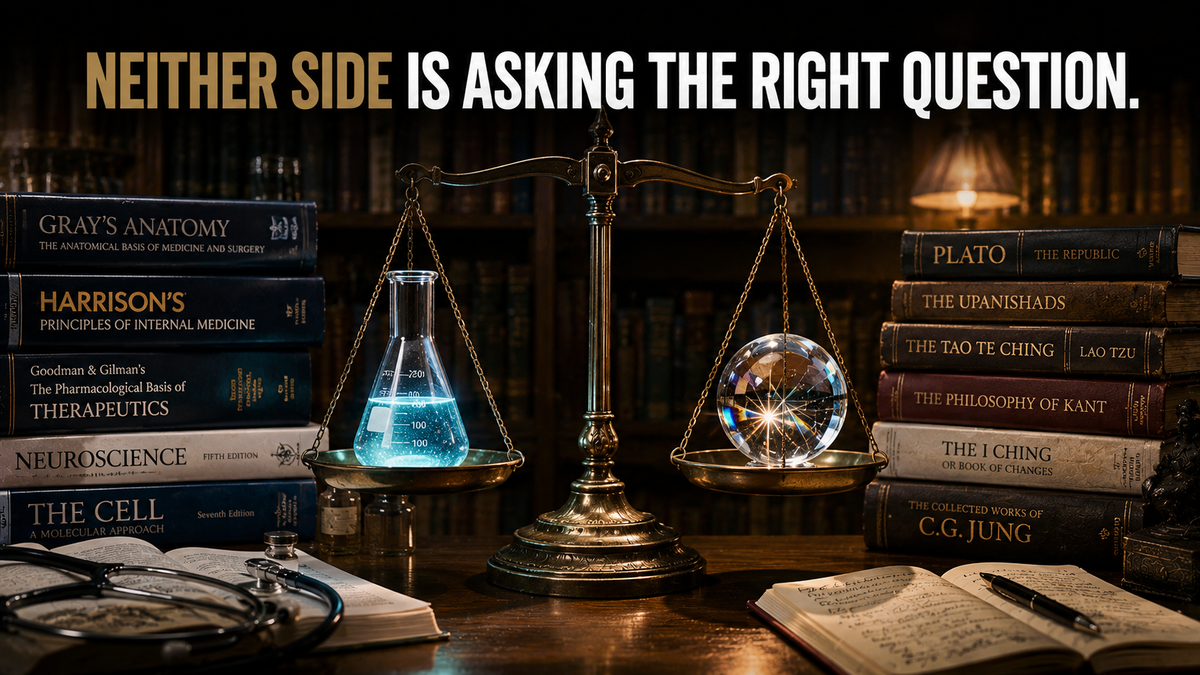
Here's what the "true or false" framing quietly assumes: that mysticism is making an empirical claim about the physical universe, the same category of claim as "water boils at 100 degrees Celsius at sea level," and that it should therefore be falsifiable by the same standards. Some traditions absolutely do make claims like that, and where they do, hold them to it — if someone tells you a specific ritual will cure a verifiable, diagnosable illness in place of medicine, that claim is testable, and it has, repeatedly, failed the test, sometimes with tragic consequences. That's not mysticism being unfairly persecuted by science. That's a literal claim getting checked against literal reality, the same as any other literal claim should be.

But most of what actually constitutes the mystical traditions humans have carried for millennia was never making that kind of claim in the first place. Ritual, myth, divination, meditation, prayer — these were rarely pitched as competitors to physics. They were operating in an entirely different register: meaning, orientation, grief processing, the construction of a coherent self capable of facing an incoherent world. Demanding that register answer to the standards of a laboratory is like grading a marriage on its load-bearing capacity. Wrong instrument. Wrong category. The mismatch is the entire problem, and neither side of the cage match usually notices, because both sides are too busy enjoying the fight.

You cannot disprove a ritual's ability to make grief bearable by proving it didn't move any physical particles. Those were never the same claim.

What the Skeptics Get Right, and What They Miss

The skeptical position deserves real credit for one thing: it has correctly identified that an enormous amount of grift hides inside the mystical vocabulary, precisely because "it's spiritual" has become a remarkably effective shield against scrutiny. Charge someone $3,000 for a "energy alignment package" and call it ancient wisdom, and you've built a business model that's nearly immune to the kind of consumer protection that would instantly apply if you sold the same promise wearing a pharmaceutical label instead. The skeptics are right that this needs calling out, loudly, specifically, by name. Where they miss is in assuming that because some practitioners are running a grift, the entire category of human meaning-making through ritual and symbol must be one. That's a scope error, not a correction.

What the Believers Get Right, and What They Miss

The believer's position deserves credit too, and it's this: they've correctly identified that a purely materialist account of human experience leaves enormous, important territory unaddressed — the felt sense of meaning, the experience of synchronicity, the genuine psychological utility of ritual and symbol, none of which disappear just because you can't put them under a microscope. Where believers miss is in sometimes treating that felt utility as proof of a specific metaphysical mechanism — insisting the tarot card moved because a spirit guided it, rather than sitting with the more interesting, harder-to-dismiss possibility that the human mind does something genuinely remarkable with structured symbol and attention, with or without anything supernatural attached.

A Better Question Than "Is It Real"

Here's what I'd ask instead, and I've found it produces far more honest conversations than the binary ever did: what is this practice actually doing, who does it serve, and does it hold up under honest scrutiny of its actual effects rather than its metaphysical claims? Does a ritual help someone process a loss they were otherwise stuck inside? Does a reading help someone notice a pattern they'd been avoiding? Does a meditation practice measurably lower someone's reactivity over months of consistent use? Those are testable, in the only sense that actually matters to the person doing the practice — not "is there a ghost in the room," but "did this change anything real about how I'm living."

This reframing also exposes grift far more effectively than the true/false fight ever did, because grift fails this test reliably. A practice that's actually helping produces durable change you can observe over time. A grift produces dependency, escalating cost, and a customer who somehow always needs the next upsell to maintain the relief the last purchase promised but never quite delivered. You don't need a debate about the existence of energy fields to spot that pattern. You just need to watch what happens to the person's life, and their wallet, six months in.

Holding Both Without Collapsing Into Either

I don't think mysticism needs to be literally, metaphysically true to be worth taking seriously, and I don't think its inability to pass a controlled trial makes it worthless nonsense either. I think it's doing something humans have needed done since long before anyone had the vocabulary of clinical trials at all — making the unbearable bearable, making the chaotic legible, giving shape to grief and decision and transition that would otherwise just sit in a person, formless and crushing. Whether or not a deck of cards is metaphysically connected to anything has never been the most interesting question in the room. The most interesting question is what happens in the very real, very measurable human being sitting across from it.


So: next time you find yourself in the true-or-false fight about something mystical, try asking instead what it's actually doing for the person standing in front of you — and notice how much faster that question gets you to something true.

Subscribe now — make a bold move