Past Lives — What the Cards Remember That You Don't

Past Lives — What the Cards Remember That You Don't
Things we can't explain.

You don't have to believe in past lives for this to be true about you.

There is a kind of knowing that has no origin story.

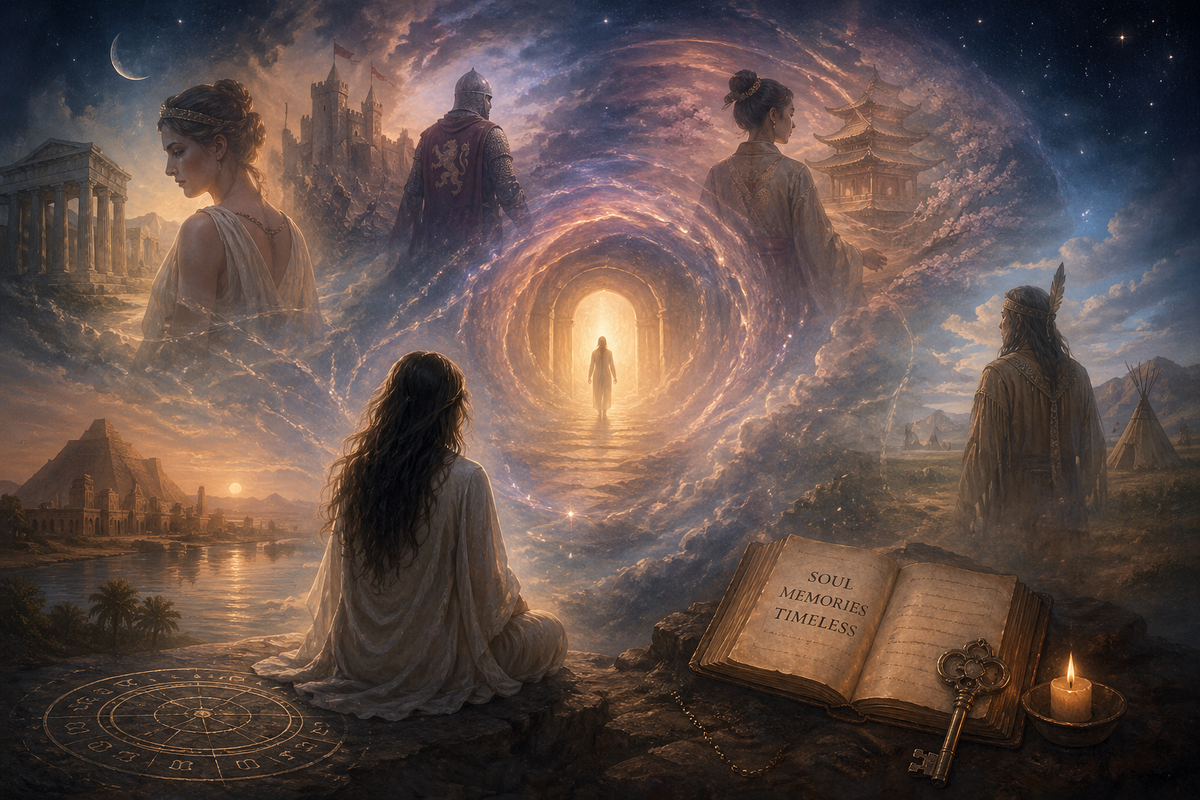
You meet someone for the first time and something in you recognizes them — not their face, not their name, not anything you could point to. Something older than that. Something that arrives before your mind has a chance to process it, like a memory that belongs to a language you no longer speak.

You visit a place you've never been and feel, inexplicably, that you've left something there.

You carry a fear that has no root in anything that has happened to you in this life. A grief that surfaces sometimes with no occasion. A longing for something you couldn't name if someone asked you to.

You have a gift that arrived fully formed — not built, not practiced into existence, but simply there, waiting, like you only needed to remember it rather than learn it.

Call it what you want. Past lives. The deep unconscious. Ancestral memory carried in the body. The collective psyche dreaming through you. Jung's collective unconscious surfacing in the particular shape of your particular wounds and gifts.

The name matters less than the recognition.

And the cards — if you let them — can take you to the threshold of it.


What Tarot Is Actually Reaching For

Most people come to tarot asking about the future.

The cards are less interested in the future than we are.

What the cards are extraordinarily good at is the below — the layer underneath the presenting question, underneath the story you've been telling yourself, underneath even the things you know you're carrying. The layer that doesn't have easy language because it predates the part of you that uses language.

That layer is where past life material lives. Or ancestral material. Or the deep psychic inheritance that your conscious mind has never had access to but your body has always known.

The tarot doesn't care what you call it. It just keeps pointing at it.

And the three cards that point most insistently, most reliably, most deeply into that territory are the High Priestess, the Moon, and the World.

Not because they were assigned that meaning by any tradition. But because of what they are — what they have always been pointing at, in every deck, in every reading, across centuries of human beings sitting with these images trying to understand something about themselves that ordinary thinking couldn't reach.


The High Priestess — The Gatekeeper of What You Already Know

She sits between two pillars.

One black. One white. The threshold between the known world and the one behind the veil.

She is not going to tell you what's behind it. That was never her role. Her role is to sit at the entrance to the place where your deepest knowing lives and remind you that the entrance exists — that there is a behind, that the veil is not a wall, that what you cannot consciously access is not the same as what isn't there.

When the High Priestess appears in the context of unexplained experience — the irrational recognition, the knowledge that arrived without a teacher, the feeling of having been somewhere or someone before — she is not confirming anything. She is pointing.

There is more here than you have been given language for.

She is the card of pre-cognitive knowing. Of the intelligence that runs beneath memory. Of the self that existed before this particular story began — before this name, this body, this set of circumstances that you've spent your whole life thinking of as you.

She holds a scroll. Partially unrolled. Part of it still hidden.

Not everything will be accessible at once. Some of what you carry is not ready to be read yet. But she is telling you it is there — encoded, patient, waiting for the moment when you are quiet enough and brave enough to unroll a little more of it.

The High Priestess in a past life reading is the card that says: you have a history longer than this life.

What you do with that — whether you call it literal or metaphorical, whether you explore it in meditation or therapy or simply let it inform how you hold your unexplained knowings — is entirely yours to decide.

She doesn't tell you what to believe. She just makes sure you know the veil is there.


The Moon — What Surfaces When You Stop Controlling the Narrative

The Moon is the most uncomfortable card in the deck.

Not the most frightening — that title belongs to The Tower. Not the most confronting — that's The Devil. The Moon is uncomfortable in a different and more intimate way. It is the card of the things that surface when you're not managing yourself. In dreams. In the strange grief that hits you sideways on an ordinary Tuesday. In the reaction that is disproportionate and you know it and you can't stop it.

In the irrational.

The Moon rules the territory that the conscious mind doesn't govern. The territory where past life material — or deep unconscious material, or whatever you're calling it tonight — tends to live.

Look at the card. A crayfish emerging from a pool in the foreground, beginning the long path toward the mountains in the background. Two towers flanking the path. A dog and a wolf howling at the moon, one domesticated and one wild. The moon itself with a face, dripping dew, both illuminating and distorting.

The path is real. The destination is real. But the light is lunar — partial, shifting, casting shadows that move, making familiar things strange and strange things familiar.

This is the landscape of past life work.

You are not in full light here. You are navigating by a light that shows you some things with sudden, startling clarity and obscures others completely. You will not get a clean map. You will not get certainty. What you will get, if you're willing to walk the path rather than wait for sunrise, is contact — with something older than your current story, something that has been shaping you from below without your conscious permission.

The Moon in a reading about unresolved patterns or unexplained responses is asking one question:

Where did this actually come from?

Not the story you've constructed around it. Not the reasonable explanation you've offered yourself and others. The actual origin. The one that predates the narrative. The one that lives in the pool the crayfish is still climbing out of.

You don't have to dredge the whole pool. But you do have to acknowledge it exists.


The World — The Moment a Soul Closes Its Account

The World is the last card of the Major Arcana.

Twenty-one. The completion of the Fool's entire journey — through every archetype, every initiation, every death and resurrection the deck contains. The figure at the center is dancing, wrapped in a purple cloth, holding two wands. Around her, the four fixed signs of the zodiac: the bull, the lion, the eagle, the angel. A wreath of completion encircles her.

She has done everything the journey required.

In past life work, The World is the card of the completed cycle. The soul that finished what it came to finish. The lesson that was actually learned, not just intellectually grasped but metabolized — lived through, broken down into something the soul can use.

When The World appears in a reading about recurring patterns or karmic themes, it cuts both ways.

It can mean: this cycle is complete now. Whatever you have been working through — in this life, across lifetimes, in the long slow project of becoming who you actually are — something has finished. Not abandoned. Not escaped. Finished. You don't need to run the lesson again. You don't need to keep calling in the same situation with different costumes. It's done.

Or it can mean: this is what you're working toward. The completion that the current pattern is moving you toward, even when the pattern feels like chaos. The World doesn't appear to mock you with what you haven't reached. It appears to show you the shape of what the journey is for.

There is a destination. There is a reason the crayfish in the Moon card is walking the path.

The World is what the path is moving toward.


The Patterns That Don't Belong to This Life

Here is what to notice.

Not the ordinary repetitions — the ones that clearly trace back to childhood, to identifiable wounds, to the particular way your specific caregivers shaped your nervous system. Those matter enormously and they deserve their own work. But they have origins you can point to.

Notice the other kind.

The fear that is specific and sourceless. Not general anxiety — something particular. A visceral response to a specific thing, place, sound, time period, type of person, that has no event in your history that could have created it.

The skill that was already there. The thing you picked up and immediately knew. Not talent in the sense of aptitude — something deeper. A familiarity. The feeling of returning to something rather than encountering it.

The grief without a referent. The mourning of something you never had in this life, or never lost in any way you can name. The longing that doesn't attach to any particular object.

The connection that felt like recognition. The person you met and immediately trusted or immediately feared with an intensity that the actual evidence of who they were didn't support.

These are the places worth sitting with.

Not rushing toward an explanation. Not immediately constructing a past life narrative around them — that can be its own kind of avoidance, turning the mystery into a story you can manage. Just sitting with them. Letting the High Priestess do her work. Letting the Moon illuminate what it illuminates.

And watching what surfaces.


How to Work With This in a Reading

You don't need a special past life spread. You don't need a particular deck or a particular ritual.

What you need is a different question.

Most tarot questions are forward-facing: what's coming, what should I do, how will this resolve. Past life work asks backward and downward: what is this pattern actually about, where does this feeling actually come from, what am I carrying that I didn't consciously pick up.

Sit with that question before you pull cards. Let it settle in your body, not just your mind. Ask it from the place that already knows something is there — not the place that wants to be entertained.

Then pull slowly. Look at the images before you look at the meanings. Let the images speak to the part of you that processes in pictures and feelings rather than words.

Notice what you feel, not just what you think. Notice where in your body something lands. Notice which card you keep coming back to, which one makes you look away.

The cards are not going to hand you a past life biography. That is not their job and honestly not what would serve you most. What they will do, if you let them, is point at the places where the story goes deeper than this life — and invite you to go there too.

Not to excavate. Not to perform spiritual work for an audience of yourself.

Just to know.

Just to sit at the threshold with the High Priestess and acknowledge that the veil is there. That behind it is something real. That you have a history longer and stranger and more layered than any single lifetime could contain.

And that the knowing of that — even without the full story, even without the proof, even without a name for what you believe about it — changes something.

It makes the irrational fear a little less shameful. The sourceless grief a little less lonely. The inexplicable gift a little less like an accident.

It makes you, in a way that is hard to articulate but easy to feel, a little more whole.


What You Don't Have to Decide

You don't have to believe in reincarnation.

You don't have to reject it.

You don't have to resolve the question at all. Some of the most important questions are not the ones that get answered — they're the ones that, in the living with them, make you more honest, more curious, more willing to sit with what you don't understand rather than flattening it into something you can manage.

The cards don't ask you to believe anything. They ask you to look.

The High Priestess holds the scroll. Some of it is still hidden.

The Moon lights the path with its partial, shifting light. The crayfish keeps climbing.

The World waits at the end — patient, complete, dancing — for the moment the journey has done what journeys do.

You don't have to know what any of it means.

You just have to be willing to walk the path long enough to find out.


Past Lives — What the Cards Remember That You Don't.

Not a biography. Not a belief system. A threshold.

The High Priestess holds the veil open.

The Moon lights the way.

The World shows you what the walking is for.

You don't have to know what you believe.

You just have to be willing to look.

Subscribe now — make a bold move