Reading for Skeptics: What 10,000 Readings Taught Me About People Who Don't Believe
You don't have to believe in tarot. You just have to be honest about what's actually happening in the room.
The Inner Rebel
You don't have to believe in tarot. You just have to be honest about what's actually happening in the room.

Every skeptic walks into a reading the same way: arms crossed, jaw set, ready to catch me in the con. I love it. Genuinely. Ten thousand readings in, the skeptics are some of my favorite people to read for, because they're paying closer attention than anyone else in the room.
Here's the thing nobody tells you about tarot: I'm not reading the future. I'm reading you — your face when a card lands, the half-second pause before you answer a question, the thing you correct yourself about mid-sentence. Seventy-eight pieces of cardstock are a structure for a conversation, not a crystal ball plugged into the universe's server. And a structured conversation, done honestly, is uncomfortably accurate, with or without anyone believing in magic.
The Three Kinds of Skeptic
After ten thousand readings, I can sort skeptics into rough categories within the first two minutes, and each one needs something completely different from me. There's the polite skeptic, who's here because a friend dragged them and they're being a good sport — they'll give me almost nothing to work with, on purpose, just to see if I notice, which I always do, and saying so out loud is usually the moment the real reading starts. There's the combative skeptic, who's arrived specifically to debunk me, and who is, without exception, the most fun, because they ask better questions than most believers ever bother to. And there's the quiet skeptic, who doesn't believe a word of it but is in enough pain that they're willing to sit across from anything that might help, magic or not, and honestly doesn't care which.
None of them need me to convince them tarot is "real." All of them need the same thing, underneath the posture: forty-five minutes where someone pays close, structured attention to their actual life, instead of half-listening while waiting for their turn to talk.
Pattern Recognition With Plausible Deniability
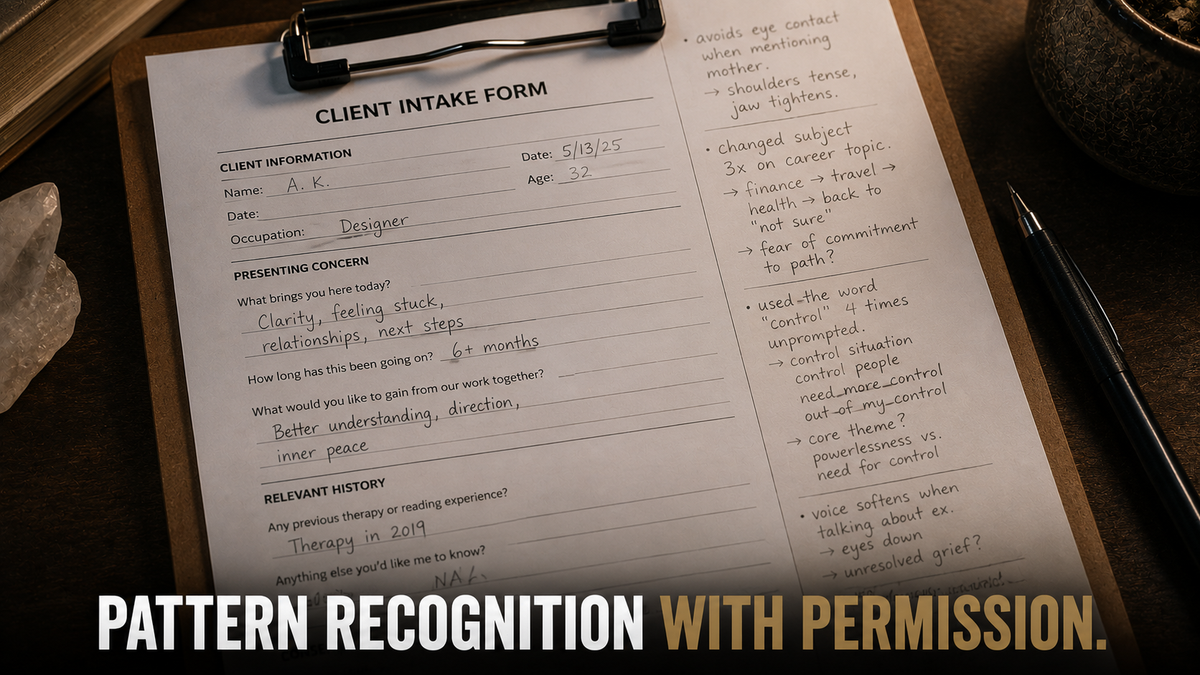
Let's call this what it actually is: tarot is applied pattern recognition with a deck for cover. Humans repeat themselves. We fall for the same kind of person, sabotage ourselves the same way, avoid the same conversation in six different relationships. A good reader isn't psychic. A good reader has sat across from a few thousand humans and noticed the patterns are not as original as we'd all like to think. The cards just give us both permission to say the quiet part out loud.
Skeptics don't disprove tarot. They just make sure I actually earn the read instead of coasting on vague mysticism.
The believers, frankly, are easier — and not always in a good way. Hand a believer The Tower and they'll nod solemnly and accept doom is coming. Hand a skeptic the same card and they'll say "okay, but doom about what, specifically," and now we're doing the actual work: naming the collapsing relationship, the job they already know is ending, the version of themselves they've outgrown but haven't buried yet. The skeptic's resistance isn't an obstacle to a good reading. It's the engine of one.
The Cold Reading Accusation, and Why I Welcome It
Skeptics love the phrase "cold reading," and they're not wrong to reach for it — vague statements, fishing questions, reading body language and feeding it back dressed up as insight, all of that is a real technique, and bad readers absolutely lean on it. I'd rather a skeptic accuse me of it on day one than sit through forty-five minutes being charmed into not noticing. So I tell them straight up: yes, I'm reading your face. Yes, I'm noticing your posture. Yes, the question I just asked was partly a fishing expedition. None of that makes the conversation worthless — a good detective also reads a room, and nobody calls detective work fake because it involves observation.
The difference between a cold read and a real one is what happens after the fishing question lands. A cold reader vaguely agrees with whatever the client just confirmed and moves on. A real reader takes what the client confirmed and pushes one layer deeper — not "you're going through a hard time with someone close to you," which could describe half the planet on any given Tuesday, but "the hard time isn't really about them, it's about what you're scared it means about you if you finally admit they're not who you thought." That's not a guess that gets lucky. That's pattern recognition built on ten thousand prior conversations, applied in real time to the specific person sitting across from me.
What I Actually Learned
What ten thousand readings actually taught me has very little to do with whether the universe is sending messages through a fifteenth-century Italian card game. It taught me that almost everyone already knows the truth about their situation before they sit down. They just need a non-judgmental, slightly theatrical excuse to say it out loud to someone who won't immediately try to fix them, talk them out of it, or make it about themselves. The cards are the excuse. The honesty was already sitting there, just unspoken.
It also taught me that skepticism and openness are not opposites, no matter how often they get treated that way on both sides of this argument. The most useful readings I've ever given were to people who didn't believe a word of the mythology and still let themselves answer the questions honestly anyway. Belief was never the requirement. Honesty was.
So here's my actual pitch to skeptics, and it has nothing to do with belief: come sit down, keep your arms crossed, ask hard questions, push back on every card. I'm not selling you cosmic certainty. I'm offering forty-five minutes where someone asks you what's actually true, and a deck of cards gives you cover to answer honestly — including to yourself.
The believers think the cards know something. I think you already know something, and the cards just make it socially acceptable to admit it mid-afternoon to a near-stranger instead of at 3am to your ceiling.
So which is scarier — that a deck of cards might be telling you something true, or that you already knew it, and just needed permission to say it out loud?