Since When Did Healthcare Become a Personality Test?
You can have a malignant tumor and still lose points for "tone."
Stories from the Edge
You can have a malignant tumor and still lose points for "tone."
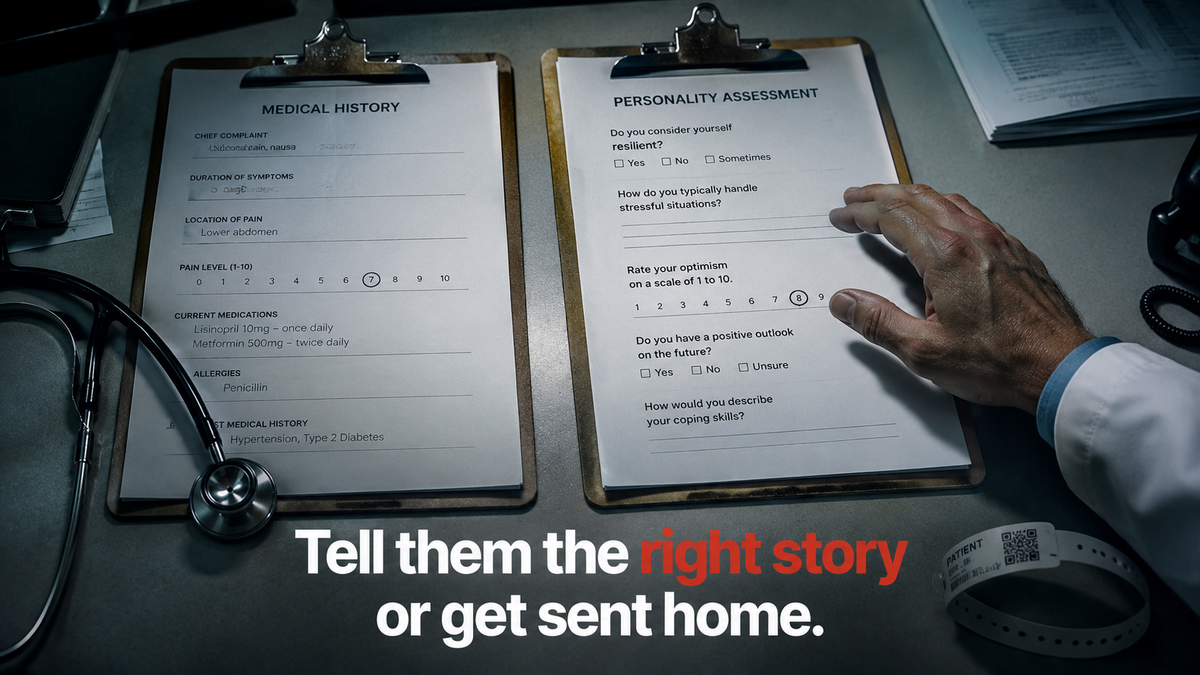
I have a working theory: somewhere in medical school, between anatomy and "first, do no harm," there's a secret elective called Vibes 101. Because nothing else explains why a waiting room full of actual symptoms quietly turns into an audition.
You know the drill. You walk in with pain, and within ninety seconds you're doing math you didn't sign up for: smile enough to seem "pleasant," but not so much they think you're fine. Wince enough to be believed, but not so much you're "dramatic." Mention the pain once, clearly, then never again, because round two reads as "anxious." Stay calm, because hysterical women have been a medical diagnosis since before women could vote, and apparently some of that paperwork never got shredded.
Nail the performance and you get taken seriously. Flub it — too flat, too frustrated, too tired to charm a stranger in a paper gown — and suddenly you're "anxious," or "stressed," or my personal favorite, a patient who "doesn't present typically." Translation: we don't believe you, but we'll write it down so it sounds clinical.
A Brief, Infuriating History Lesson
Let's go back, because this didn't start with a rude triage nurse on a Tuesday. The word "hysteria" comes from the Greek hystera — uterus — because for roughly two thousand years, the official medical position was that a woman's womb could simply wander around her body causing trouble, and the cure ranged from marriage to leeches to, eventually, a tidy stay in an asylum. We like to think we left that behind with corsets and bloodletting. We did not. We just changed the vocabulary. "Hysterical" became "anxious." The wandering womb became a wandering diagnosis that still somehow always lands on the same word: not real.
This is the part nobody wants to sit with: the entire architecture of "doesn't present typically" was built on a baseline of one kind of patient — historically white, male, and calm under pressure because nobody had ever taught him his pain wasn't believable in the first place. Everyone else has been retrofitted into a system that was never actually built to hear them, and then blamed for not fitting it smoothly.
The Charm Offensive
So what actually happens in the exam room? Healthcare becomes a charm offensive. The sickest people I know are also, by necessity, some of the most likable people I know — not because illness makes you charming, but because they've learned, the hard way, that charm is the toll booth between them and treatment. Be unlikeable while sick and watch how fast "advocate for yourself" turns into "difficult patient" in someone's notes.
Here's the performance checklist nobody hands you at the front desk, but everyone with a chronic illness eventually builds in their head anyway:
- Describe the pain with confidence, but not certainty — certainty reads as "googled it," and nothing kills credibility faster than sounding informed.
- Cry exactly once, briefly, and apologize for it immediately, so it reads as "genuinely struggling" instead of "unstable."
- Bring a partner or parent if you can, because a second, calmer voice in the room mysteriously makes your pain 40% more believable.
- Never, ever say "I read that this could be—" because suggesting your own diagnosis, even correctly, gets filed as a personality trait, not a clue.
- Smile at the front desk, the nurse, and the doctor, in that order, like you're running for a tiny, humiliating local office called Patient Who Gets Taken Seriously.
None of that is an exaggeration for comic effect. People with endometriosis, autoimmune disorders, and chronic pain conditions report, over and over, identical years-long sagas: symptom, dismissal, symptom, "have you tried therapy," symptom, a different doctor, finally — years later — a diagnosis that was, in hindsight, written all over the very first visit. The average diagnostic delay for several autoimmune conditions is measured in years, not appointments, and a meaningful chunk of that delay isn't a mystery of medicine. It's a backlog of being disbelieved by people in lab coats who outranked them in the room.
If you have to be pleasant to be believed, what you're being measured for isn't your health. It's your behavior.
The Chart Has a Memory, and It's Not on Your Side
Let's talk about the data trail this leaves behind, because it's the quietest part of the whole machine. Once "anxious" lands in your chart, it doesn't leave. It gets copy-pasted forward, visit after visit, provider after provider, quietly reframing every future symptom as a feeling instead of a finding. You didn't get a diagnosis. You got a personality assigned to you by a stranger who saw you for twelve minutes, and that personality now precedes you into every future room, like a bad Yelp review you can't dispute.
This is how a person can show up with a genuine, escalating, physically verifiable problem and still get handed a pamphlet about stress management. Not because the new doctor is lazy or cruel, but because the chart already told them a story before the patient opened their mouth, and most of us are trained to trust the paper trail over the person standing in front of us holding it.
Who This Isn't About
None of this is a complaint about individual doctors, most of whom are overworked, underpaid by the system that employs them, and triaging twenty problems with the tools and time budgeted for ten. The average primary care visit clocks in somewhere around fifteen minutes, which is roughly enough time to take a blood pressure reading, glance at a chart, and make a snap judgment about whether you're a "straightforward" patient or a "complicated" one — a judgment that, once made, is brutally hard to undo for the rest of the visit, let alone the rest of your medical history.
This is about a structure that quietly rewards bedside charisma over clinical curiosity, rewards speed over investigation, and punishes patients for failing to manage someone else's comfort while their own body is on fire. The doctor isn't the villain here. The doctor is also a cog being run through a throughput machine that measures "efficiency" in patients-per-hour, and "difficult" patients are, by definition, inefficient — they ask questions, they push back, they take longer, they cost the clinic money in a system where time is the only resource nobody has enough of.
It's Not Just Women, Either
To be fair to the whole miserable system: men get a different flavor of the same poison. Stoicism is the performance expected of them instead of pleasantness, and it's just as deadly in its own way — men are statistically less likely to seek care at all, more likely to downplay symptoms until they're catastrophic, and more likely to die of conditions that were entirely treatable if caught early, because the script handed to them was "don't make a fuss," not "advocate loudly." Different costume, same play: perform the emotion the system expects, or pay for the gap between your authentic state and the audition you didn't know you were doing.
Maybe the real scandal isn't that some patients are "difficult." It's that "difficult" has quietly become a stand-in diagnosis for "I stopped performing for you" — and that we've built an entire system sophisticated enough to run advanced imaging and gene sequencing, but not sophisticated enough to separate a patient's tone from a patient's truth.
So here's the question worth sitting with the next time you're handed a paper gown and a clipboard: if you weren't likable today — if you were tired, terse, scared, or simply done explaining yourself for the fourth time — would you still get the same care? And if the honest answer is no, what exactly are we calling this system? Because "healthcare" feels generous.