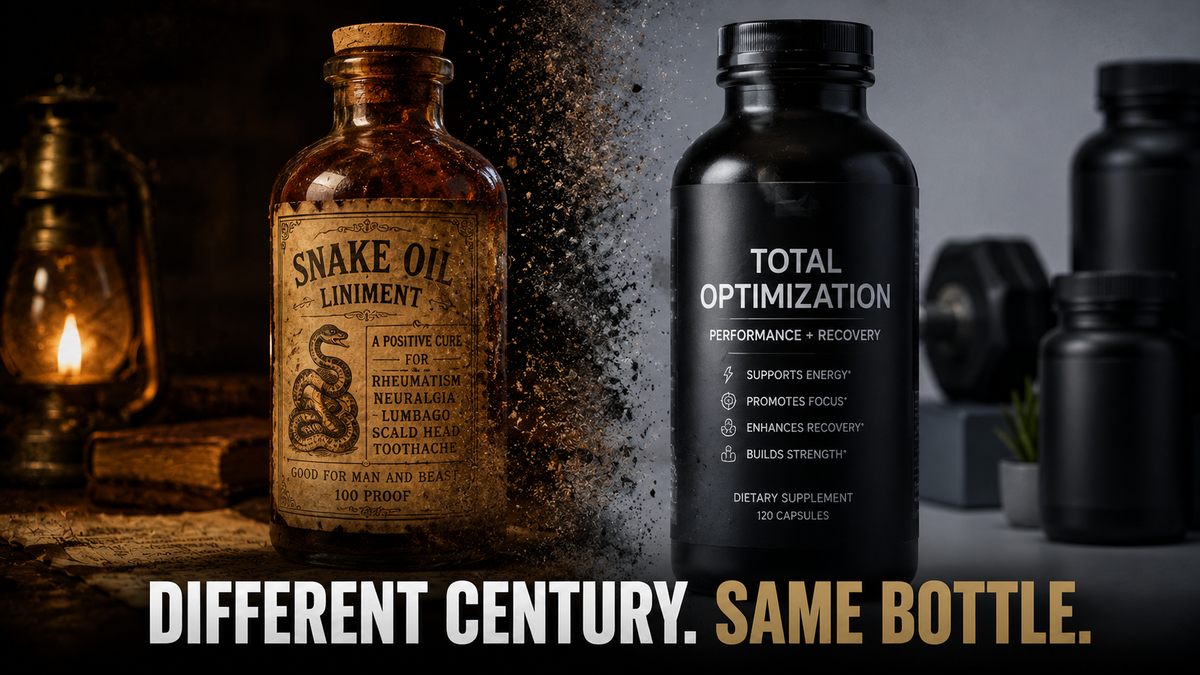
We Used to Call It Snake Oil. Now It Has 4 Million Subscribers and a Supplement Line.
Same con. Better lighting.
The Inner Rebel
Same con. Better lighting.
The traveling salesman with the wagon full of tonics and the carefully rehearsed pitch is one of the oldest stock characters in American folklore for a reason — he was real, he was everywhere, and he worked, decade after decade, on people who badly wanted to believe relief was as close as the bottle in his hand. We like to think we left him behind with black-and-white photographs and patent medicine labels. We did not. We just gave him a ring light, a podcast feed, and an algorithm that does the traveling for him now.
The modern version doesn't need a wagon. He needs a strong jaw, a calm cadence, a story about how mainstream medicine failed him personally, and a supplement line waiting at the end of a forty-minute video essay about ancestral living, mitochondrial health, or whatever this month's framework happens to be. The tonic changed. The shape of the con — personal transformation story, implied secret the establishment is hiding, product at the bottom of the funnel — has barely moved at all.
The Tell Is in the Timeline
Here's the pattern worth watching for, because it shows up with almost mechanical consistency: the persona usually arrives before the product, and the product usually arrives before the peer-reviewed evidence, if the evidence ever arrives at all. A creator builds trust through vulnerability and story — a health crisis, a system that failed them, a dramatic before-and-after — and only once that trust is established does the actual commercial offer show up, dressed as a natural extension of the journey rather than the destination it was always headed toward.
If the personal story always conveniently ends at a product you can buy, the story was never really about healing. It was the marketing department, wearing a confession.
Compare that sequence to how legitimate health science actually moves: evidence first, peer review second, cautious clinical recommendation third, and only much later, if ever, a product — usually built by an entity other than the researcher who discovered the underlying mechanism, specifically because conflicts of interest are taken seriously enough in genuine research to want that separation. The influencer economy inverts every step of that order and calls the inversion authenticity.
"They Don't Want You to Know" Is Doing a Lot of Work
Almost every version of this pitch leans on some variation of institutional betrayal — doctors don't want you to know, Big Pharma is hiding this, the FDA suppressed that. Some skepticism of institutions is earned and reasonable; medicine has a real history of dismissing patients, especially women and people of color, and of moving slower than it should on legitimate, inconvenient findings. But "they're hiding this" is also the single most reliable rhetorical device in the grift toolkit, precisely because it preemptively explains away the absence of evidence. No studies support the claim? That's not evidence against it — that's proof of the cover-up. The framing makes the grift unfalsifiable by design, which is exactly the opposite of how legitimate knowledge is supposed to work.
Why It's So Hard to Walk Away
None of this is really about the gullibility of the audience, and treating it that way misses what's actually happening. People gravitate toward these figures because they offer something real medicine often fails to provide: time, attention, a narrative that makes a confusing chronic problem feel coherent and controllable, and a sense of agency in a system that frequently leaves patients feeling like passive recipients of fifteen-minute appointments. The parasocial relationship built with a wellness influencer can feel, emotionally, more like being cared for than an actual rushed visit with an overworked physician does — even when the actual content of the advice is worse, or actively harmful.
That emotional substitution is the real product, more than any specific tincture or protocol. The supplement is just the receipt for a transaction that already happened in the listener's nervous system the moment they felt heard.
How to Spot It Without Becoming a Cynic About Everything
The goal isn't to distrust every person on the internet who talks about health — that overcorrection just pushes people back toward the institutions they left for understandable reasons. A more useful filter: does this person's business model survive being wrong? Do they show you the limits and uncertainty of the evidence, or only the parts that flatter the conclusion they're selling? Would they still be saying this if there were no product attached to the end of the sentence? Snake oil has never needed you to be stupid. It's only ever needed you to be in pain, hopeful, and a little tired of being told to wait for better evidence.
So: the next time a calm voice tells you the truth has been hidden from you and happens to be selling the cure at the end of the same video — what's actually more likely, a conspiracy big enough to suppress real medicine, or a business model old enough to have a wagon in its family tree?