Tarot Stopped Promising Your Future and Started Explaining Your Present. That's the Upgrade.
The fortune-telling version was always going to disappoint somebody. The self-understanding version actually works.
The Inner Rebel
The fortune-telling version was always going to disappoint somebody. The self-understanding version actually works.

For most of tarot's modern popular history, the pitch was fortune-telling: will I get the job, will he come back, when will I meet someone. That version of tarot has a structural problem it could never fully escape, which is that it's making a falsifiable prediction about an unknowable future, and unknowable futures have an excellent track record of not cooperating with anyone's deck of cards. Current research on how people actually use astrology and tarot now shows a real, measurable shift away from that exact framing — less "what will happen to me," more "why do I feel this way" and "what actually suits me." I've watched this shift happen in real time across thousands of readings, and I think it's not just a trend. It's tarot finally being used for the thing it was always actually good at.
Why the Fortune-Telling Version Was Always Going to Fail
Predictive tarot puts the cards in a fight they can't consistently win — competing against an unknowable future that has its own mind, its own randomness, its own refusal to be flattened into a single linear outcome. Every time a predictive reading turned out wrong, which was often, the whole practice took the credibility hit, even though the actual mechanism — pattern recognition, structured reflection, a prompt for honest self-examination — had nothing to do with literal fortune-telling in the first place. The format was doing genuinely useful psychological work while being marketed, and judged, as something else entirely: a weather forecast for your soul, evaluated by the same standards as an actual weather forecast.
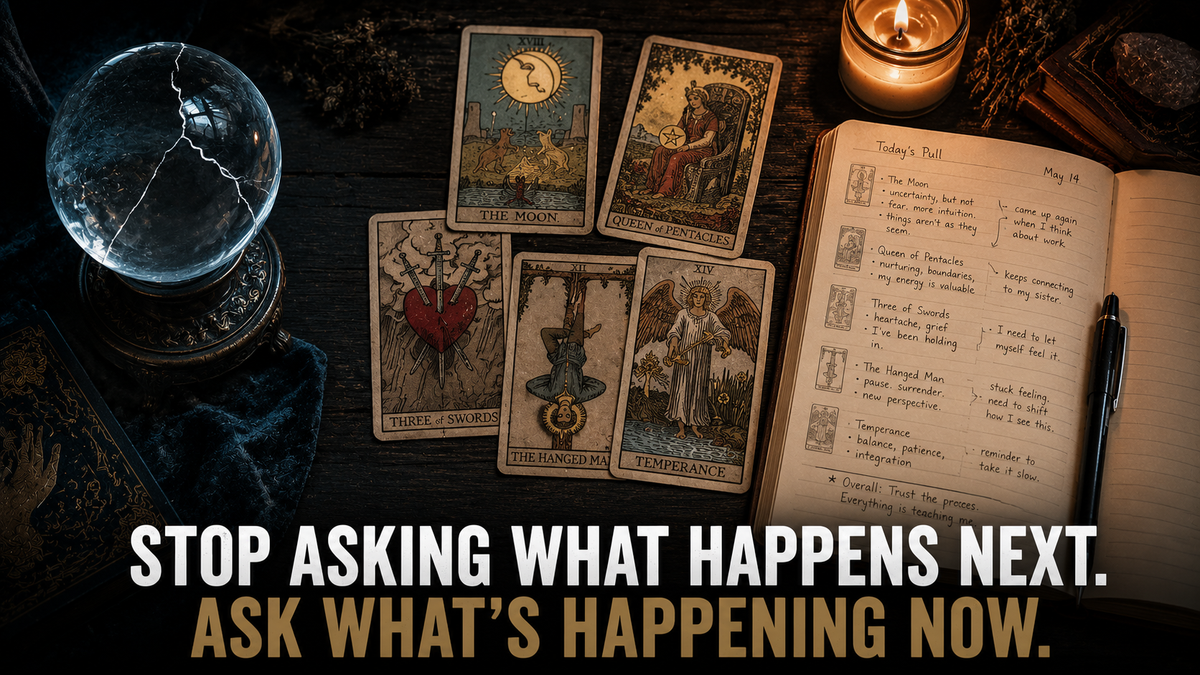
Tarot was never reliably good at telling you what will happen. It has always been remarkably good at telling you what's already happening, underneath the version of events you've been telling yourself.
What the Self-Understanding Version Actually Asks Of a Card
Pull The Eight of Cups under the predictive framing, and the question is "does this mean I'm about to leave my relationship." Pull the exact same card under the self-understanding framing, and the question becomes "what am I currently walking away from, that I haven't admitted out loud yet, even to myself." The second question is answerable, immediately, by the person holding the card, using information they already have and simply hadn't organized. The first question requires the universe to cooperate on a timeline nobody controls. One of these framings sets the reading up to succeed regardless of what the future does. The other sets it up to be graded, eventually, like a weather forecast that's wrong half the time.
This Also Explains the Generational Shift, Not Just the Format Shift
It's not a coincidence that this shift toward self-understanding tracks closely with a generation navigating unusual instability — a job market that broke a lot of the old promises, a slower and less certain path to the traditional markers of adult stability. When the future itself feels less predictable than it used to for almost everyone, a tool that claims to predict it stops being useful and starts being almost cruel — one more system promising a certainty it can't deliver. A tool that instead helps you understand your own reaction to an unpredictable present has obvious appeal precisely because it doesn't need the world to cooperate in order to work. It just needs you to be honest, today, about what you're actually carrying. That's a far more reliable raw material than the future ever was.
What This Means for How I Actually Read Now
I stopped promising outcomes in readings years ago, not because I lost confidence in the practice, but because I gained more respect for what it's actually built to do. When someone asks me "will this relationship work out," I no longer pretend the cards can answer that question, because they can't, and any reader telling you otherwise is selling certainty they don't have. What I can tell you, with real confidence built on thousands of readings, is what's actually happening in your half of that relationship right now — the pattern you're repeating, the question you're avoiding, the version of the truth you've been managing rather than saying out loud. That's not a lesser version of tarot. It's the version that was always true, finally being asked the question it can actually answer.
So: the next time you're tempted to ask a card what's going to happen, try asking instead what's already happening that you haven't said out loud yet — and notice how much more useful an answer you actually get.