The Doctor in Your Feed Was Never Real
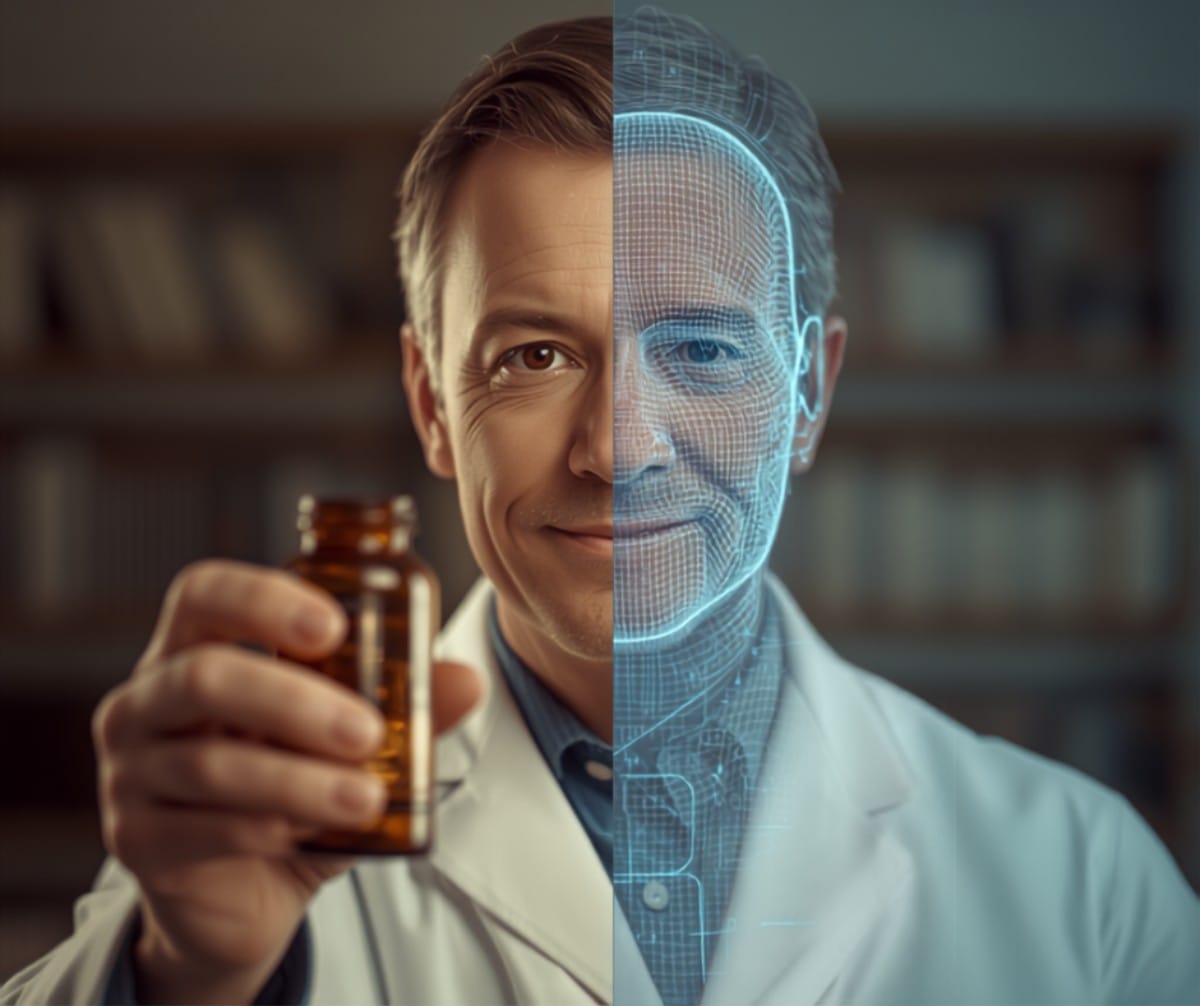
Somewhere in your feed right now, a doctor who does not exist is explaining why the pill in his hand fixed what your real doctor couldn't. He has a white coat, a warm bedside voice, and a face built by a machine that has never attended medical school, never taken an oath, and never met a patient. He is one of hundreds. A New York Times investigation published this summer identified a sprawling network of AI-generated wellness personas — doctors, "Eastern medicine" practitioners, satisfied customers — pitching supplements to American consumers, many of them older women managing chronic pain or looking for an alternative to prescription drugs they can no longer afford. The ads work because they are built to work. The people in them are not.
A Face for Every Claim
The mechanics are cheap and getting cheaper. Generative video tools can now produce a convincing "expert" — invented name, invented credentials, invented clinical experience — in the time it takes to write a script. Some operations skip invention entirely and borrow a real person's face. In December, the UK fact-checking charity Full Fact traced a network of accounts pushing menopause supplements under the brand Wellness Nest that had digitally hijacked the likeness of Professor David Taylor-Robinson, a public health physician at the University of Liverpool, and repurposed real conference footage to put fabricated claims about "thermometer leg" in his mouth. The video ran up 365,000 views before it came down — and only after his own children flagged it, because TikTok's first review found nothing wrong. The same network had already used the late Dr. Michael Mosley and cardiologist Dr. Aseem Malhotra without consent. Wellness Nest told Full Fact it had never authorized any of it.
That's the quieter, more unsettling version of the story: it doesn't even require inventing a face. It just requires stealing one that already carries trust, and letting the algorithm do the rest.
The Law Already Covers This. Enforcement Doesn't.
Ask the regulators and they'll tell you nothing about this is technically a gray area. "The same truth-in-advertising standards apply whether a spokesperson is human or AI-generated," Phyllis Marcus, vice president at the National Advertising Division of BBB National Programs, told the trade outlet NutraIngredients this week. The FTC's existing rules on health claims and testimonials don't carve out an exception for synthetic spokespeople — an AI avatar making a false claim is still a false claim, full stop. Asa Waldstein, a compliance consultant who works with supplement brands, put it more bluntly: labeling a fake doctor as AI-generated doesn't retroactively make an unsupported disease claim legal. "A mistake would be assuming that an AI disclosure fixes everything," he said.
So the statute exists. What's missing is anyone positioned to act on it before the ad has already run its course — been seen, believed, and converted into a sale — and the account behind it has vanished and reopened under a new name. The Council for Responsible Nutrition, the industry's own trade group, tried to draw a line between legitimate supplement makers and the operations running these campaigns, calling the fraud "clear violations of the law" rather than an industry norm, and pressing for a mandatory FDA product registry and more enforcement funding. It's a reasonable distinction on paper. It does nothing for the person who already bought the shilajit.
Who the Ads Are Built For
This isn't spray-and-pray marketing. The Times investigation found the ads clustering around chronic pain, menopause, and diseases where conventional medicine has been slow, expensive, or dismissive — precisely the conditions where a warm, confident face promising a natural fix lands hardest. Older women, the investigation found, are the primary target, not incidentally but by design: it's the demographic most likely to trust a man in a white coat and least likely to reverse-image-search his face. Industry research backs up why brands are drawn to the tactic even as it targets the vulnerable — a 2026 Harris Poll found that while 78% of consumers say AI makes advertising feel less authentic and 73% say they'd trust an AI-suspected ad less, the same synthetic spokespeople are cheaper, infinitely scalable, and impossible to catch off-script. The trust cost is a known, accepted trade, priced in before the campaign launches.
The Trust Economy Nobody Regulated
What makes this durable isn't the technology — deepfakes have existed for years — it's the business logic underneath it. A human influencer can go off-message, ask for more money, or grow a conscience. A synthetic one cannot. Marcus's own framing gives away the stakes: "consumer trust cannot be automated." Except, functionally, that's exactly what's being attempted — trust manufactured at scale, aimed at the people least equipped to question it, monetized before any regulator finishes reading the complaint. The rules on the books were written for a world where a false claim had a person attached to it, someone who could be sued, licensed, or shamed. Increasingly, there's no one there. Just a face, a script, and a storefront that will be gone by the time anyone official looks up.
Sources
- "When the influencer isn't real: AI amplifies familiar supplement advertising risks," NutraIngredients, Aug. 24, 2026
- "AI Influencers Are Selling You Health Supplements With Fake Ads," The New York Times
- "The Council for Responsible Nutrition Responds to NYT's AI Wellness Influencer Investigation," Nutritional Outlook
- "Investigation reveals AI deepfake doctors spreading misinformation and endorsing supplements," The Independent via AOL
- "I Never Asked For This," The Harris Poll, 4A's, and Infillion, 2026
- FTC Health Products Compliance Guidance