The Government Just Told You What It Used to Deny. What Does That Change?

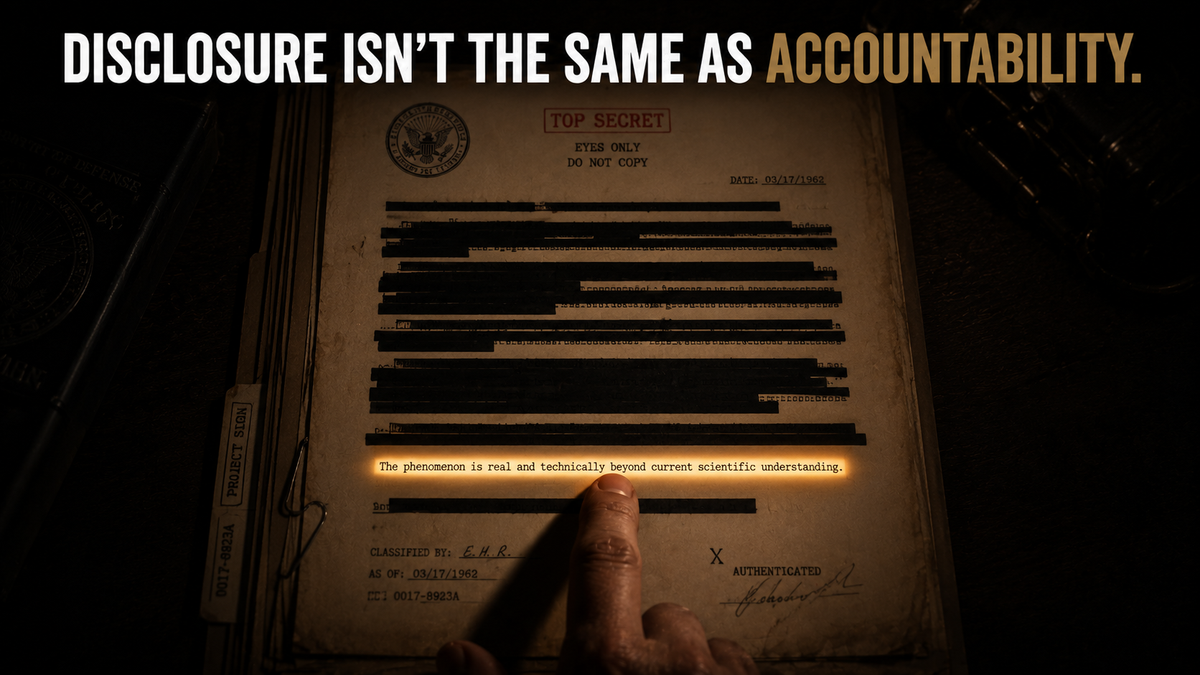
Disclosure is not the same operation as correction. Most systems perform the first and skip the second.
Messages to Humans

Disclosure is not the same operation as correction. Most systems perform the first and skip the second.

In 2026, a sequence repeated itself across several unrelated domains, closely enough in time to be observed as a pattern rather than a coincidence: information previously denied, minimized, or withheld was released — UAP files, decades-old behavioral research, an investigation into a previously dismissed medical phenomenon. In each case, the public was told, in effect, that the version of events it had been offered for years was incomplete. In none of these cases did disclosure arrive accompanied by an equivalent correction of the institutional behavior that produced the original denial.

This distinction is worth stating precisely, because the two are routinely conflated, to the benefit of whoever is doing the disclosing. Disclosure answers the question: what actually happened. Correction answers a different question entirely: what will prevent the same withholding from happening again. A system can perform the first completely while doing nothing whatsoever about the second, and from the outside, in the moment of release, the two are nearly impossible to distinguish.

The Function of a Disclosure Event

Observe what a disclosure event actually accomplishes for the institution performing it, independent of its content. It converts an open, ongoing demand — keep pressing, keep asking, keep investigating — into a closed, completed one: the information has now been provided, the matter is resolved, continued pressure looks unreasonable. This conversion happens regardless of whether the underlying behavior that caused the original secrecy has changed at all. A system can release the file and change nothing about how the next file gets handled, and the act of releasing is, on its own, usually sufficient to satisfy the immediate pressure that produced it.

A disclosure tells you what was hidden. It rarely tells you whether the hiding has stopped.

This is not necessarily cynicism about the specific people involved in any given release — many disclosures are produced by individuals genuinely committed to transparency, working inside institutions that are not. The pattern described here operates at the level of institutional incentive, not individual intention, which is precisely why good-faith actors inside a system can produce a disclosure event without it functioning as the correction the public assumes it represents.

The Believability Problem, Inverted

A secondary effect of these disclosure events deserves attention, because it runs in an unexpected direction. The people whose original reports were dismissed — the diplomat with unexplained neurological symptoms, the witness to an unidentified aerial phenomenon, the historian alleging a pattern of testing on vulnerable populations — do not receive, alongside the disclosure, a restoration of the credibility they lost during the years of being disbelieved. The institution updates its public record. It does not retroactively repair the reputational and psychological cost borne by the individuals who were correct before it was convenient to say so. The system's accounting closes. The individual's does not.

What Would Distinguish Genuine Correction

A useful diagnostic, applicable beyond any single disclosure event: genuine correction produces a change in process, not merely a change in available information. It would look like an institution voluntarily reducing its own classification authority, rather than ceding it under sustained external pressure. It would look like restored credibility and acknowledgment for the specific individuals dismissed during the period of denial, not just a general statement that the matter is now better understood. It would look like a disclosure that arrives before public pressure makes withholding more costly than releasing, rather than after. None of the disclosure events observed this year meet that bar, which does not make them worthless — partial transparency is still more than none — but it does mean the underlying mechanism that produced decades of denial remains, by any honest accounting, intact and available for the next file.

The relevant question, then, is not whether to feel satisfied by a given disclosure. Satisfaction was never the correct response to being told the truth eventually, on someone else's schedule, after years of being told otherwise. The relevant question is narrower: has anything changed about who gets to decide what stays hidden, and for how long — or has only the specific secret changed hands, while the mechanism that produced it waits, undisturbed, for its next occasion to use.


So: when the next disclosure arrives — and it will — ask not whether you finally got the truth, but whether anything was actually corrected in how that truth was withheld in the first place. If the answer is no, what exactly was disclosed: the information, or just the timing of when you were allowed to have it?

— The Signal

Subscribe now — make a bold move