80% of Gen Z Believes in Astrology. The Headlines Mocking Them For It Missed Why.
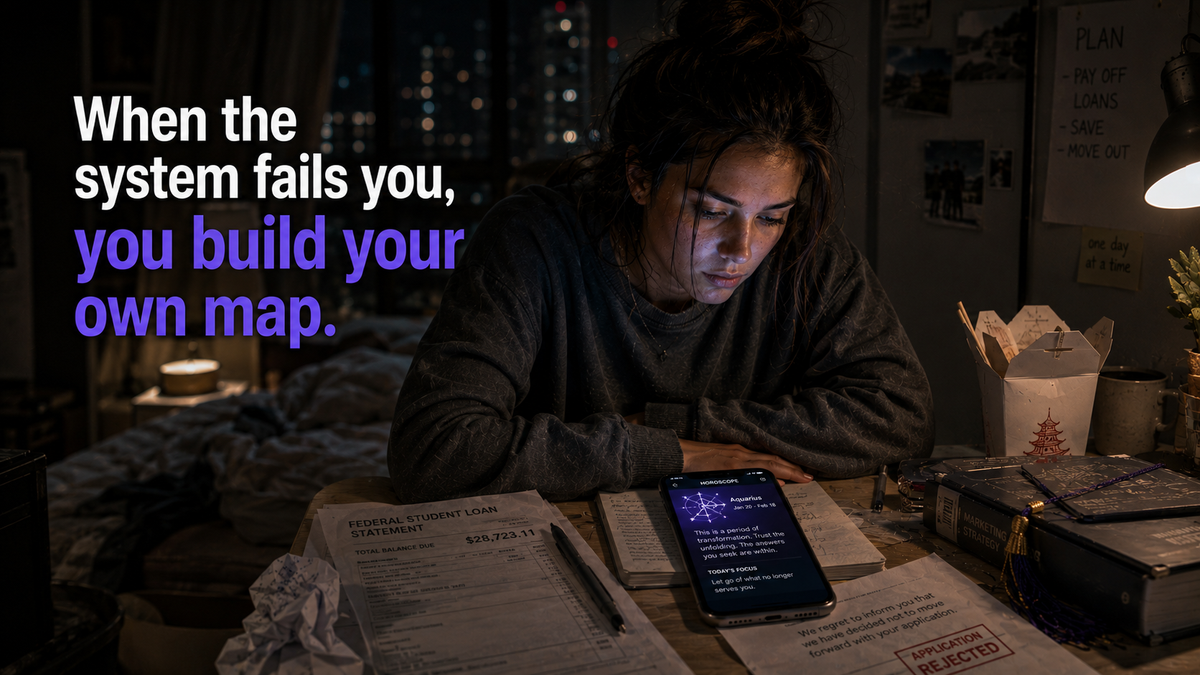
Call it gullibility if you want. Or you could ask what happens to a generation's sense of control when the job market does what this one did.
Stories from the Edge
Call it gullibility if you want. Or you could ask what happens to a generation's sense of control when the job market does what this one did.
Recent surveys put belief in astrology among Gen Z and younger millennials at around 80%, with roughly 30% of U.S. adults overall consulting astrology, tarot, or some form of fortune-telling. The coverage of this statistic tends to follow a predictable script: bemused references to crystals and birth charts, a quote from a psychologist about confirmation bias, maybe a joke about Mercury retrograde. What that coverage almost never asks is the more interesting question sitting directly underneath the number: why this generation, why now, and why is the actual content of the belief shifting in a specific, traceable direction.
What Changed Isn't Just the Belief — It's the Use
The most telling detail in the research isn't the percentage. It's the functional shift in how astrology and tarot are actually being used. Historically, the dominant use case was predictive — what will happen, when will I meet someone, will I get the job. Current usage among younger people skews heavily toward something else entirely: self-understanding. The question being asked has shifted from "what will happen to me" to "why do I feel this way" and "what actually suits me." That's not a trivial distinction. It's the difference between using a framework to forecast an uncontrollable future and using a framework to make sense of an already-confusing present, and the second use case maps directly onto a specific, well-documented condition: a generation entering adulthood during a period of unusually acute uncertainty, reaching for any available tool that helps make a chaotic internal experience feel organized and named.
Nobody consults a horoscope to feel certain about the future. They consult it to feel less alone in not understanding the present.
The Economic Backdrop That Rarely Makes It Into the Joke
The timing here isn't coincidental. This surge in spiritual self-understanding tools has tracked alongside a sharply climbing unemployment rate for recent college graduates and a broader, well-documented sense among younger people that the standard markers of adult stability — homeownership, steady long-term employment, a clear career trajectory — have become considerably less reliable than they were for previous generations. When the external systems that used to provide structure and predictability — a stable job, an affordable path to a home, an economy that rewarded the credentials you were told to get — stop functioning as advertised, people don't stop needing structure. They go looking for it somewhere else. Astrology and tarot, used as self-understanding tools rather than predictive ones, fill exactly that gap: they don't promise to fix the unstable external world, but they offer a stable internal framework for understanding your own reactions to it.
Mockery as a Failure to Ask the Obvious Follow-Up Question
Treating this as simple generational gullibility requires skipping over the much more obvious question any of this data should prompt: gullible compared to what alternative? The generation mocking astrology as irrational rarely directs the same energy at, say, the rationality of an economic system that told an entire cohort a degree guaranteed stability and then delivered record youth unemployment instead. Astrology doesn't claim to be empirically verified physics, and most of its current users aren't confused about that — surveys consistently find that a large share of people who read horoscopes for fun or self-reflection don't actually believe in literal causal mechanisms behind them. The mockery tends to come from people implicitly comparing astrology's truth claims to science's, while never holding the actual functional alternatives — therapy access, career counseling, affordable mental health support — to the same scrutiny for being equally out of reach for a lot of the same population.
What This Generation Is Actually Asking For
Read closely, the pattern isn't "Gen Z believes the planets control destiny." It's closer to: a generation facing unusual instability built a low-cost, accessible, socially shareable framework for self-reflection, using inherited cultural material that happened to be lying around, because the institutions that used to provide that kind of structure — religious community, stable career paths, accessible therapy — became less available or less trusted at exactly the moment this generation needed them most. That's not a punchline. That's a reasonably rational response to a genuinely destabilized set of circumstances, dressed in a vocabulary that's easy to mock precisely because it doesn't pretend to be anything more serious than what it actually is.
So: before the next joke about Gen Z and their moon signs, what's the actual alternative being offered instead — and is it more accessible, more affordable, or more honest about its own limits than a birth chart is?