Comcast Turned Your Router Into a Motion Sensor. The Fine Print Explains Who Else Gets to Watch.
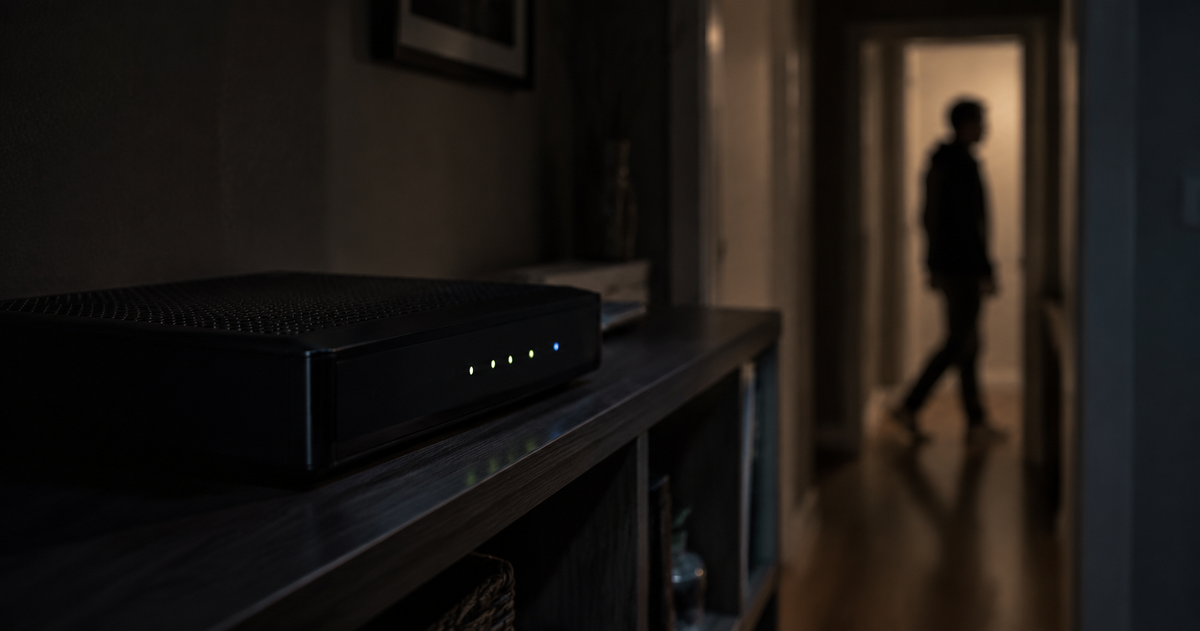
Comcast turned on a new feature this week called WiFi Motion. It uses the radio signal already bouncing between your Xfinity router and every device in your house to detect when a body moves through a room — no camera, no separate sensor, nothing to install. The company is billing it as free home security, bundled into a new platform called Xfinity Shield. Buried in the support documentation is a sentence that matters more than the feature itself: Comcast can hand the data this generates to law enforcement, courts, or "any dispute to which Comcast is a party" without telling the customer first. The interesting part isn't that a router can sense motion. It's what else that same signal can do, and who decided the fine print was the right place to disclose it.
The technology is older than the marketing
WiFi Motion works by reading beamforming feedback information, or BFI — a stream of housekeeping data that every WiFi-connected device sends back to its router so the router can aim its signal more efficiently. That data travels unencrypted. It has to, for the network to function. A body moving through the space between a router and a stationary device — a printer, a game console, a smart speaker — disturbs that signal in a measurable way. Comcast is packaging this as a convenience: get a push notification when something moves in your empty house.
What Comcast's press release doesn't mention is that researchers have already demonstrated this same class of signal can go further than detecting that someone moved. Trained models built on beamforming data have been shown to identify who is in a room with accuracy north of 99 percent, without that person carrying a phone or any device at all. It's enough that other people's devices are talking to the router nearby. The technology Comcast just shipped to millions of homes as a free perk is a close cousin of a surveillance capability that doesn't require a camera, a warrant for a wiretap, or the target's knowledge that they're being sensed.
Opt-in, until it isn't your data anymore
Comcast's public statements stress that WiFi Motion is opt-in and, in its current form, doesn't identify specific people or reach through WiFi extenders. Fair enough — as shipped, today, on this feature. But those are product decisions, not hard limits of the underlying physics. The signal itself doesn't know the difference between "detect motion" and "identify occupant." The restraint is a policy choice sitting on top of a much more capable pipe, and Comcast, a publicly traded company answering to shareholders and periodically to subpoenas, is the one holding the dial.
That's what makes the disclosure language worth reading twice. The Xfinity support page states that Comcast "may disclose information generated by your WiFi Motion to third parties without further notice to you in connection with any law enforcement investigation or proceeding, any dispute to which Comcast is a party, or pursuant to a court order or subpoena." No promise to fight the subpoena. No promise to notify the customer after the fact. Just a reservation of the right to hand over a record of movement inside a private home, generated by a feature marketed as a safety upgrade, whenever a legal process asks for it.
A pattern, not an accident
This is the same shape as every other quiet expansion of home surveillance infrastructure over the last decade: a genuinely useful feature, opt-in at launch, built on a data stream with capabilities well beyond the advertised use case, governed by terms of service most customers will never open. Smart doorbells did this with facial recognition. Smart speakers did it with always-listening microphones. Now it's the router — the one device in the home that's already positioned to see everything, because everything in the house talks to it anyway.
The difference this time is scale. Comcast doesn't need customers to buy a new device or install anything. The gateway is already leased, already installed, already reporting to Comcast's infrastructure. Xfinity Shield's paid tier, Shield Select, adds "AI-enhanced monitoring" for $15 a month — language vague enough to cover a wide range of future capability without requiring Comcast to announce what that capability actually is until it ships. The free tier is the foot in the door. It normalizes the idea that the router watches, and that watching is a feature, not a liability.
What gets asked, and what doesn't
Nobody at Comcast has claimed WiFi Motion identifies individuals today. The company's language is careful, and probably accurate, about what the feature does in its current release. What it doesn't do is explain why a home-security notification system needs a legal-disclosure clause broad enough to cover any subpoena in any dispute Comcast happens to be party to — which, for a company Comcast's size, is constantly. Nor does it explain what happens to the underlying signal data once collected: how long it's retained, whether it's used to train future versions of the "AI-enhanced monitoring" tier, or whether the opt-in applies only to notifications and not to the collection itself.
Those are the questions that don't fit in a product launch. They also aren't the kind of thing that gets answered until the data has already been requested, disclosed, and used somewhere — a courtroom, an investigation, a dispute between neighbors — where the person who unknowingly generated it finds out only when it's already evidence.
Sources
- Comcast adds motion sensing to millions of its newer routers, with a privacy catch — TechCrunch
- Comcast just turned millions of Xfinity routers into motion sensors — 9to5Mac
- Comcast's Xfinity Shield and WiFi Motion sensing — The Verge
- Comcast Introduces Intelligent Home Protection: Xfinity Shield — Comcast press release
- WiFi Motion support and disclosure terms — Xfinity