The Mood Metric: How Big Tech Is Patenting Your Face for Work
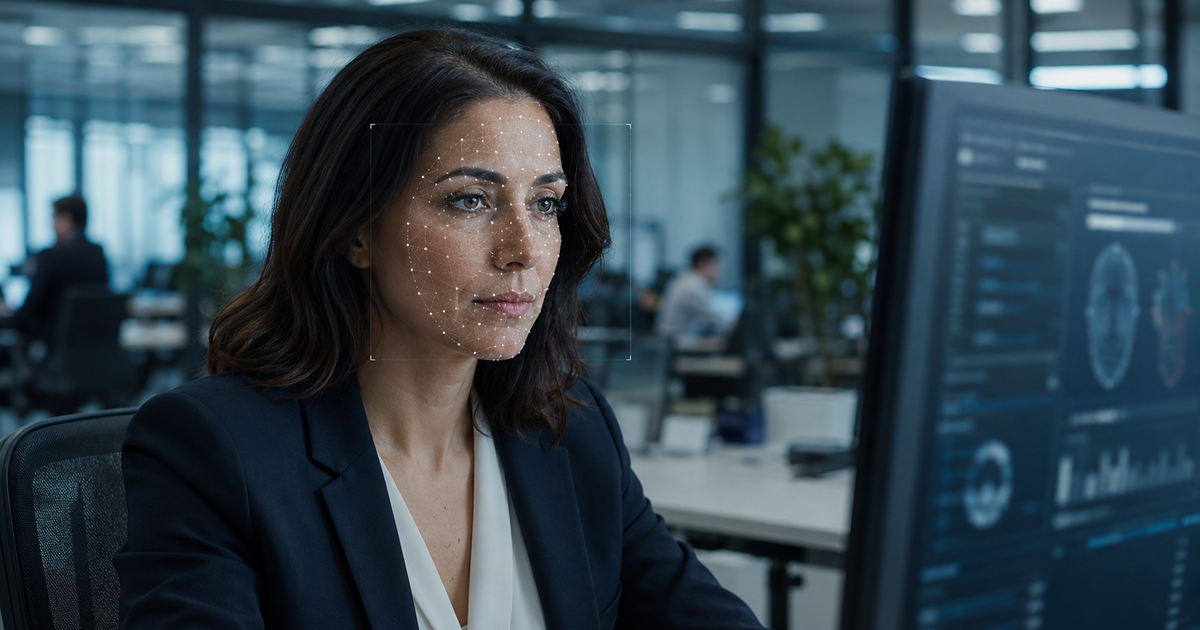
Microsoft, Amazon, Nvidia, and Meta have all filed patents in recent years for technology that reads human emotion through facial expression, tone of voice, or body language. None of the four has announced a product. But patents are not filed for sport, and the pattern — four of the largest employers and infrastructure providers in the world, independently building toward the same capability — is the story, regardless of whether any single filing ever ships. The question is no longer whether your face can be read by a machine. It's who gets the read, and what they do with it.
The Filings
Financial Times columnist Elaine Moore laid out the pattern in a recent piece: Microsoft has a patent application for "intentional virtual user expressiveness," designed to detect a user's emotional state in a video meeting and reflect it back through facial animation, on the theory that "facial emotions can be detected to enable richer meeting services." Amazon has pursued patents for emotion-detection through its smart speakers — voice analysis sensitive enough, according to one filing, to flag that a user sounds ill and prompt Alexa to recommend flu medicine. Nvidia has filed for technology that infers emotion from audio data for animation purposes. Meta's patent, per a description in Futurism, "listens to you and everything you do, combines it with other data, and feeds it all to a mood-predicting AI."
Most patents never become products. Big tech files thousands of speculative claims a year precisely so a competitor can't box them in later. But a patent is also a document of intent — a company's own written record of what it thinks might be worth owning. Four companies, each sitting on a different layer of the stack people already run their working lives through — operating systems, voice assistants, chips, social platforms — all filing for the same underlying capability is not proof of a coming product. It is proof of a shared appetite.
Already Deployed, Just Not on You Yet
Facial monitoring in the workplace isn't hypothetical. It's already running, just further down the wage ladder than the office workers reading Financial Times columns. Truck drivers have been the test case: companies like Visage Technologies sell driver-facing camera systems that watch for eyelid droop and head position and flag distraction or drowsiness to fleet managers. The American Transportation Research Institute has documented that these cameras remain deeply unpopular among the drivers subjected to them, with female drivers reporting particular discomfort at being recorded alone in a cab for hours at a stretch.
That's the usual order of operations for workplace surveillance technology: it's piloted on workers with the least leverage to refuse it, then normalized upward. Gartner already puts the number at 60% of large employers using some form of "bossware" — keystroke logging, desktop capture, location tracking — on their white-collar staff. The infrastructure for monitoring is already installed. Emotion detection isn't a new category of surveillance. It's the next field to fill in on a form that's mostly already filled out.
The Numbers Nobody Asked For
The public has been asked, in the abstract, whether it wants this. Pew Research found 70% of Americans oppose employers using facial recognition to analyze employee expressions. When The Conversation, a nonprofit outlet, ran its own survey on workplace emotion AI, the top concern respondents raised wasn't accuracy or bias — it was the plain loss of privacy, and the stress and paranoia that comes from knowing your face is being scored.
Tara Behrend, a Purdue psychology professor who studies bossware, made the mechanism explicit in a conversation on the American Psychological Association's podcast: employees under this kind of monitoring become preoccupied with "putting forward the right image or the right behaviour," and that preoccupation itself produces the distraction and burnout the technology is nominally meant to manage. The tool built to measure whether you're a happy, productive worker degrades the thing it claims to measure. This isn't a bug regulators will eventually catch. It's the design.
Whose KPI
The pitch, when companies make one, is always employee wellbeing — catching burnout early, flagging distress before it becomes a resignation. The Amazon patent's flu-medicine recommendation is the same logic in consumer form: helpful, proactive, a little bit magic. But a system that can flag illness or distress to a caring assistant is the identical system that can flag it to a manager building a performance file. There is no version of this technology where the read is available to you and unavailable to the person who signs your paycheck. The sensor doesn't know the difference between care and control. Only the org chart does.
None of the four companies has said they intend to sell this into workplaces. They don't have to say so. The patent exists so that if the market wants it — and a market that already tolerates keystroke loggers and location pings has given no indication it won't — the technology is ready, owned, and defensible. The wait is not for the technology to mature. It's for the normalization to catch up to it, the way it already has for the truck drivers nobody in the FT comment section thinks about.
Sources
- "Is your boss watching your face? The next frontier of workplace surveillance," The Star / Inc.
- "Workplace mood-monitoring tech may not be something to smile about," The Irish Times
- "Nvidia Catches Feelings With its Emotion Reading AI Patent," The Daily Upside
- "Microsoft May Use Emotion Detection for 'Richer' Work Meetings," The Daily Upside
- "Microsoft Files For a Face-Tracking Patent," Reclaim The Net