HAARP Was Never Secret. That's What Made It Terrifying.
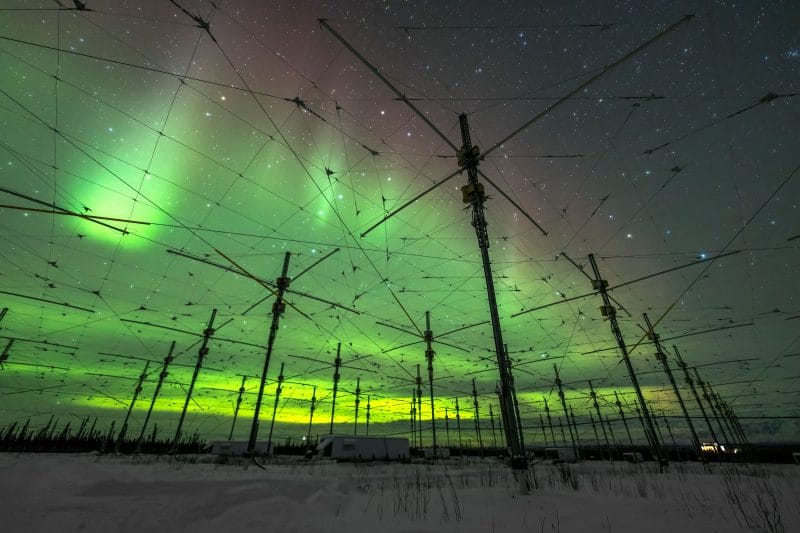
The government published the patents. They listed the coordinates. They handed out press releases. And somehow that made people trust it less, not more.
The High-frequency Active Auroral Research Program sits on 33 acres in Gakona, Alaska, 200 miles northeast of Anchorage. It consists of 180 antennas arranged in a grid, each one 72 feet tall, capable of producing 3.6 million watts of radio frequency energy directed at the ionosphere — the electrically charged layer of atmosphere beginning about 60 miles up. The stated purpose is scientific research: studying how the ionosphere behaves when disturbed, with applications for communications, navigation, and surveillance systems. The funding came from DARPA, the US Navy, and the US Air Force. It opened in 1993. The location is public. The research papers are mostly published. You can take a tour during their annual open house.
None of this stopped HAARP from becoming, over the following three decades, the most blamed machine in American conspiracy history. It has been accused of causing Hurricane Katrina, the 2010 Haiti earthquake, the 2011 Fukushima earthquake and tsunami, droughts, floods, wildfires, and the disruption of migratory bird patterns. It has been credited with mind control capabilities, the ability to knock aircraft out of the sky, coordination with chemtrail programs, and at least one theorized role in the disappearance of Malaysia Airlines Flight 370. The YouTube videos explaining these connections have accumulated hundreds of millions of views. The books have been translated into a dozen languages. And at the center of all of it sits a facility that never tried to hide — because it didn't have to.
Where the Theories Actually Come From
The modern HAARP conspiracy has a specific origin point, and it isn't anonymous internet speculation. In 1995, a researcher named Nick Begich Jr. — son of a former Alaska congressman — co-authored a book called Angels Don't Play This HAARP. The book's central argument wasn't that HAARP was classified. It was that HAARP's publicly available patent history was itself alarming, and that the government's open acknowledgment of the program made its implications more disturbing, not less. Begich wasn't wrong about one thing: the patents are strange.
Bernard Eastlund was a physicist who worked for ARCO — the oil company — in the 1980s, when ARCO held the rights to vast natural gas reserves in Alaska and was looking for ways to monetize them. Eastlund developed a series of patents, beginning with US Patent 4,686,605 filed in 1985, describing a method of using high-frequency radio waves to heat the ionosphere and produce effects at a distance. The language in Eastlund's own patents mentions, explicitly: "weather modification," the ability to disrupt missile flight paths, the potential to knock out communications over large geographic areas, and the creation of "artificial ionospheric mirrors" for surveillance purposes.