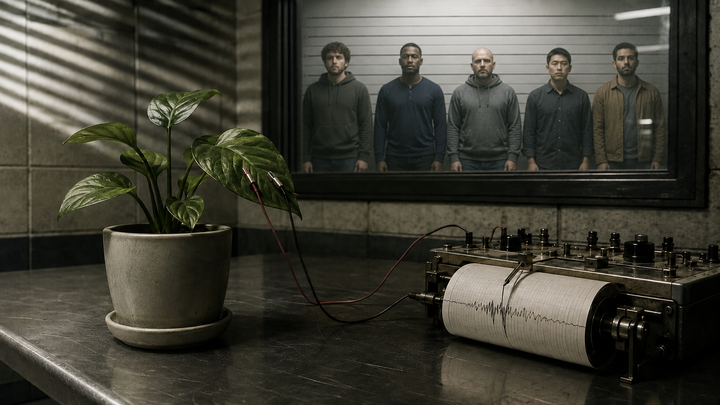
Mirror, Mirror on the Wall, How Do I Blame Them All?

Mirror, Mirror on the Wall, How Do I Blame Them All?

Something went wrong. Not a catastrophe. Just the ordinary kind of wrong — something damaged, something missed, something promised and not delivered.

You ask the person responsible about it.

And then something quietly remarkable happens.

"I" becomes "we."

Nobody can quite remember the details. The circumstances were complicated. Other people were involved — their actions, previously irrelevant to the conversation, are now introduced as evidence.

Funny how accountability can turn one person into a committee.

Accountability isn't an accusation

Asking someone to acknowledge their part in something is not an attack. Most people understand this in theory. In practice, for certain people, the arrival of responsibility triggers something closer to a threat response.

Healthy accountability sounds like: I did that. I shouldn't have. What do I owe you?

What comes instead, sometimes, is a nervous system that hears you are responsible for this and translates it, without pausing, into you are a bad person. Once that translation happens, the conversation stops being about what occurred. It becomes a trial — and the defendant has already decided to plead not guilty.

Nobody called anyone a bad person. The defense started anyway.

The Accountability Escape Sequence

The steps are consistent enough to be recognizable.

Step One: "I don't think I did that."
Step Two: "I don't remember doing that."
Step Three: "We—" (and here the pronoun does significant work) "—we were both involved in this."
Step Four: "But also, other people. Have you considered other people?"
Step Five: Their behavior. Their failures. Their part in all of this.
Step Six: Congratulations. The person who was asked to examine their role in something is now the injured party.

The inversion happens quickly enough to be disorienting. You started by saying something went wrong. You end up being asked, implicitly, why you are being so hard on them.

The technique, for what it's worth, scales remarkably well. It works in family kitchens, offices, courtrooms, and the highest positions of public life. The setting changes. The sequence doesn't.

The Royal "We"

Sometimes "we" is accurate. Shared work creates shared responsibility, and naming that honestly is mature.

But sometimes "we" is something else entirely. It's a way of making responsibility harder to locate without technically denying it. We didn't handle that very well sounds more measured than I didn't handle that very well, and it has the additional advantage of recruiting someone else into the frame.

There is one small complication: the someone else has to agree to be recruited.

When they don't — when the supposed other member of Team We quietly says, actually, leave me out of this — the person loses their argument and their supporting cast at the same moment. What happens next is instructive: they tend to become more upset, not less.

Which tells you something about what the "we" was doing.

When your consequences become their emergency

Something happened to you. Your property, your time, your trust. And then, at some point in the conversation, you notice a shift.

The question of what you experienced has been replaced by the question of what this might cost them. Their anxiety about consequences has moved to the emotional center of a situation in which they were not the person harmed.

The person who caused the problem is now experiencing distress. But the distress isn't about what they did. It's about what accountability might require of them.

That's a different thing.

Why blame feels better than a mirror

Blame is efficient in ways that reflection isn't.

If you caused my reaction, I don't have to examine my reaction.
If you escalated things, I don't have to look at what I was doing before you escalated.
If everyone contributed, I don't have to ask how much.

The mirror is the problem. It doesn't argue. It doesn't offer context. It doesn't explain away. It just shows you whatever is there — and what's there is sometimes something you didn't want to see.

Blaming someone else is a way of rotating away from the mirror without admitting you've moved.

Most of us have done some version of this. A mild one, maybe. A moment of defensiveness before we caught ourselves. A day where it was easier to focus on what someone else did than on our own contribution. The behavior exists on a spectrum, which is what makes it so familiar. Readers recognize the extreme version in someone specific. The honest ones recognize the lesser version in themselves.

The irony: accountability is cheaper

People sometimes spend days avoiding an accountability that would have taken fifteen seconds.

I did it. I shouldn't have. What do I owe you?

Fifteen seconds. Some pride. Occasionally some money or a formal apology. Real costs — nobody's pretending otherwise.

But avoiding accountability has costs too. It costs trust. And unlike most of what accountability would have required, trust is genuinely hard to repair.

It turns out it's much easier to fix whatever got broken than to fix the relationship with the person who watched you spend six months explaining why it wasn't really broken.

Return to the mirror

The emotionally mature person eventually learns to ask the mirror something uncomfortable:

What part of this belongs to me?

Not all of it, necessarily. Not always. But some.

The other approach is also available. You can stand at the mirror and ask it the older question:

Mirror, mirror on the wall — how do I blame them all?

That's the irritating thing about mirrors. They simply reflect whoever is standing in front of them.

KEEP GOING →

The Manosphere Didn't Come for Us. We Let It In.

We didn't lose ground in one dramatic defeat. We gave it away, piece by piece, in a hundred small silences.