Operation Artichoke and the Quiet Art of Drugging a Population
What got declassified, and the much longer list of what conveniently didn't.
Redacted
What got declassified, and the much longer list of what conveniently didn't.
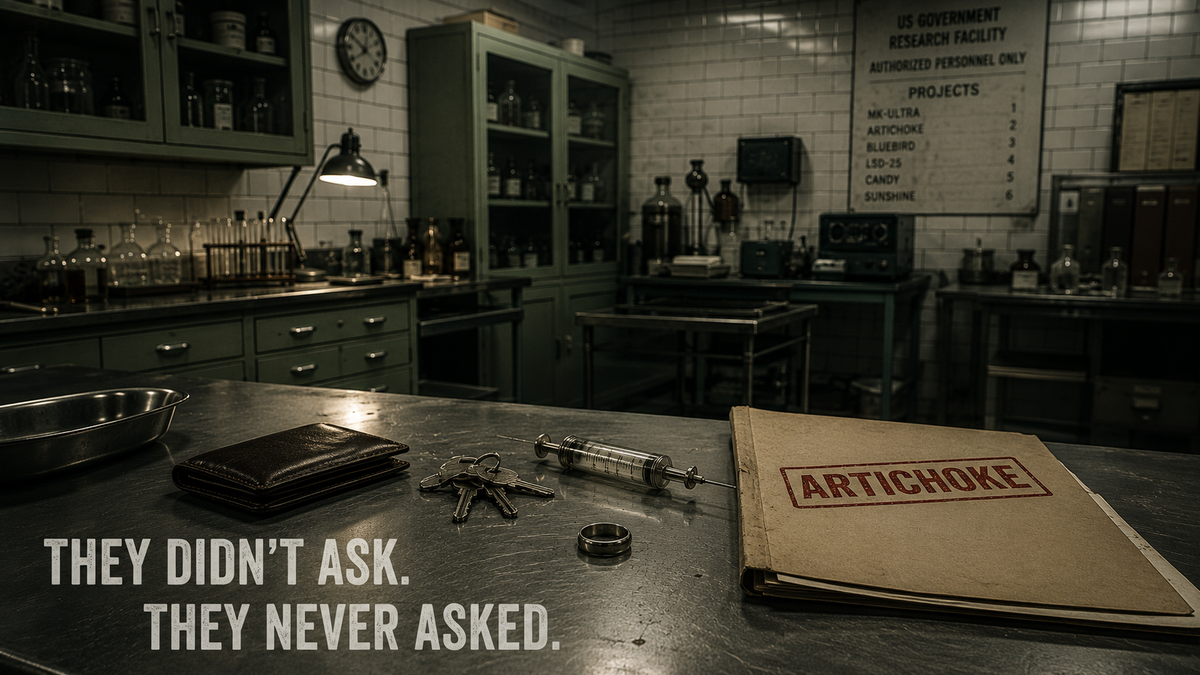
Project Artichoke ran from 1951 to 1956, under the CIA's Office of Scientific Intelligence, and its founding question — stated plainly, in writing, by the people asking it — was whether a person could be made to perform an act, including an assassination attempt, against their own will. Read that sentence as many times as you need to. This wasn't a paranoid rumor about what the CIA might theoretically be capable of. It was the literal, stated research objective of a five-year, taxpayer-funded program.
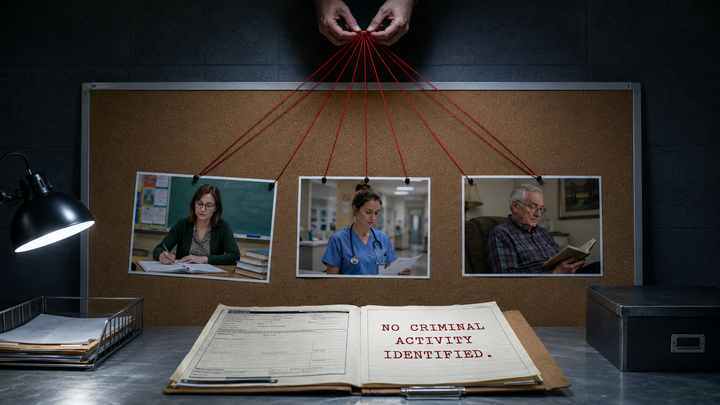
The files, declassified back in 1983 but only recently surfaced into wider circulation through the CIA's online reading room, describe testing LSD, morphine, marijuana, and mescaline on subjects, alongside hypnosis and total isolation used as forms of psychological harassment for "special interrogations." Amytal and pentothal — drugs marketed at the time as "truth serums" — were explored as tools to compel people to divulge information or act against their own interests. And then there's the detail that should have been a bigger story than it was: proposals to deliver behavior-altering chemicals covertly through food, drinks, cigarettes, and medical treatments — including vaccines and injections — aimed not at individual targets, but at influencing behavior at a population level.
Read the Plan, Not Just the Code Name
It's easy to let "Operation Artichoke" sound like a punchline — vegetable code names have a way of making horrifying things sound vaguely whimsical, which may well have been part of the point. Strip the code name away and look at the plan underneath it: a government intelligence agency drafting serious internal proposals to introduce behavior-altering substances into the food and medical supply of a population, without consent, without disclosure, as a tool of statecraft. Whether or not any specific version of that plan was ever fully executed at scale, the fact that it was seriously proposed, funded, and documented by people with the authority to actually attempt it should sit uncomfortably with anyone who assumes institutional restraint is the default.
The plan didn't need to succeed completely to tell you something true. It just needed to be written down by people who had the power to try.
Minimal Oversight, Maximum Reach
Ethical oversight across the broader MKUltra-Artichoke umbrella was, by every account that's since surfaced, minimal to nonexistent. Many experiments were proposed for, and conducted on, people who never consented and frequently never knew they'd been part of an experiment at all. CIA personnel themselves were sometimes dosed without warning by colleagues, ostensibly to study reactions under realistic conditions, with no apparent concern for what "realistic conditions" actually meant for the person living through it. One declassified account describes a subject kept under LSD's influence continuously for 77 days. There is no version of informed consent that survives contact with that detail.
What Got Released, and the Bigger Pile That Didn't
Here's the part that should temper any sense of closure this declassification might produce: in 1973, as congressional scrutiny of the broader program was intensifying, the CIA's own director ordered the bulk of MKUltra's records destroyed. What survives today — the roughly 20,000 documents recovered through a 1977 records request, plus the more recent batch that includes the Artichoke material — exists specifically because it escaped a deliberate destruction order, not because the agency chose transparency. We are not looking at "the files." We are looking at whatever happened to survive an institution's own attempt to erase its paper trail, which means the honest caption under every one of these releases is: this is the minimum, not the maximum, of what happened.
That distinction matters enormously for how much confidence anyone should have that "the full story" is now known. It isn't. It can't be. The people who ran the program made sure of that, decades before anyone reading this was old enough to file a FOIA request.
Why This Isn't Just a History Lesson
The instinct to file Artichoke and MKUltra under "things that happened in a less enlightened era" is comforting and almost certainly wrong as a predictive model. The actual lesson isn't about the specific drugs or the specific decade. It's about what an intelligence apparatus will seriously propose, fund, and attempt when it believes the proposal will never see daylight. Secrecy wasn't incidental to these programs — it was the precondition for them existing at all. Remove the assumption of permanent secrecy and the proposals likely never get written down in the first place. That means the actual safeguard was never institutional ethics. It was the possibility of future exposure, however delayed, however incomplete.
So: if the safeguard was always the risk of eventual exposure, not internal restraint — what is currently being proposed, in some agency or boardroom right now, under the same comfortable assumption that no one will ever see the paperwork?
Sourcing
- Project Artichoke — overview and timeline
- National Security Archive — "CIA Behavior Control Experiments Focus of New Scholarly Collection"
- IBTimes UK — "What Is Project Artichoke? CIA Revives Files Detailing Covert Drug Plans In Food, Drink And Vaccines"