Porkbun.com - When Customer Support Turns Patronizing — and Punishes You for Speaking Up
Asked for help. Got a link. Escalated. Got dismissed. Account blocked.
Porkbun.com: When Customer Support Turns Patronizing — and Punishes You for Speaking Up
I don’t usually write posts like this. But sometimes an experience isn’t just frustrating—it’s revealing.
This experience with Porkbun.com started as a simple request. It ended as something much more concerning.
The more I reflect on what happened, the clearer it becomes: this wasn’t just bad customer service. It was a breakdown in accountability—and a revealing look at how Porkbun.com handles customers who refuse to quietly accept poor treatment.
What Happened with Porkbun.com
I had a hosted email service through Porkbun.com that I no longer wanted. Straightforward. I reached out in advance to cancel it and to stop the constant renewal notices.
No response.
So I contacted Porkbun.com via live chat expecting basic support.
Instead, I was met with delay, deflection, and ultimately dismissal.
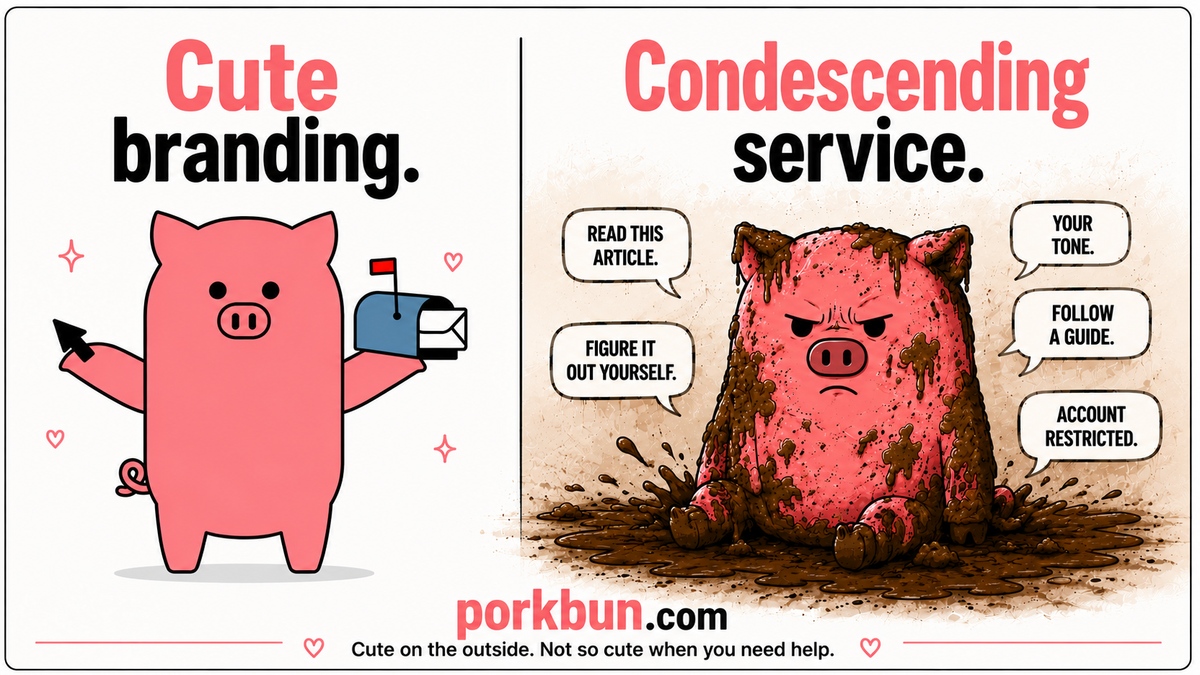
The first agent, Ashley C., took time to respond and then sent me a generic help article. Not help—an instruction manual. Instead of handling a simple request, Porkbun.com effectively told me to go figure it out myself.
Customer support exists for a reason. When a customer contacts Porkbun.com directly asking for help, the expectation is not to be redirected to documentation—it’s to be helped.
So I pushed back. I said the instructions didn’t make sense. I asked clearly for the email to be cancelled.
Still no real assistance from Porkbun.com.
Escalation at Porkbun.com That Wasn’t Really Escalation
At that point, I asked for a manager.
And that’s when the tone from Porkbun.com shifted in a way that was impossible to ignore.
Christopher K., identifying himself as a manager at Porkbun.com, joined the conversation. Not to resolve the issue—but to reframe it.
According to him, the interaction had “gone off the rails” and did not warrant my “aggressiveness.”
I had:
- Waited for assistance
- Not received help
- Asked multiple times for a straightforward cancellation
And the response from management at Porkbun.com was not to fix the issue—but to critique my reaction to not being helped.
That’s not customer service. That’s deflection.
The Pattern
Instead of stepping in and resolving the issue, the manager positioned himself as an authority on my behavior. The issue stopped being the lack of support and became my response to it.
This dynamic—being dismissed, talked down to, and reframed as the problem—is something many customers recognize immediately.
The shift from solving the issue to managing the customer. The implication that the real problem isn’t what happened, but how you reacted to it.
In my interaction with Porkbun.com, it came across as patronizing, dismissive, and condescending.
The Account Block
Shortly after this interaction, my Porkbun.com account was blocked under the explanation of an “abuse complaint investigation.”
No prior issue. No clear explanation. Just a restriction—immediately following a disagreement with support.
Because from where I’m standing, the sequence matters:
- You ask for help
- You don’t get it
- You escalate
- You’re dismissed
- Your account is restricted
That’s not just poor service. That’s a system that appears to penalize escalation rather than resolve it.
This Isn’t an Isolated Experience
After sharing my experience, I looked at other customer reviews of Porkbun.com.
The specifics vary. The pattern does not.
- Cancellation requests ignored
- Confusing interfaces and unclear processes
- Support that redirects instead of resolves
- Escalation that fails to deliver outcomes
“We requested cancellation multiple times… but the requests were repeatedly ignored… Despite providing proof of ownership, they refused to cancel the account.”
At a certain point, this stops being a one-off failure and starts looking like a systemic issue.
When Support Becomes Sarcasm
What stands out even more is how Porkbun.com responds publicly to customer complaints.
“I'm sorry you had a bad experience and that you can't rate us zero stars.”
“After all, we are the worst.”
“It looks like maybe you turned it off by accident?”
These are public responses—not private exchanges.
Instead of acknowledging frustration and working toward resolution, the tone often shifts toward correction, justification, or sarcasm.
Is the goal to support customers—or to prove them wrong?
Even the Responses Acknowledge the Problem
In some cases, the issue isn’t just what customers are saying—it’s what Porkbun.com says in response.
“We do know that we are understaffed…”
“If their chat queues are full, the chats turn off… phone hold times can be long.”
This confirms what many customers experience: difficulty accessing support when it’s actually needed.
But what stands out is not just the admission—it’s the framing.
The explanation focuses on staffing, margins, and internal priorities.
What it does not address is the customer in that moment—when help is needed.
This pattern—explaining instead of resolving—appears consistently across responses.
When Support Turns Confrontational
In some cases, the tone escalates further:
“You may want to do a little self reflection… the way to speak to other human beings could use some serious work.”
This is not de-escalation. This is judgment.
- Customers raise concerns
- The response reframes the customer as the problem
- The tone shifts from support to correction
At that point, it’s no longer about solving the issue—it’s about controlling the narrative.
What This Says About Culture
Individually, any one of these experiences could be dismissed.
Together, they tell a different story.
- Process prioritized over resolution
- Escalation without meaningful support
- Customer tone policed more than service quality
- Public responses leaning defensive rather than accountable
This isn’t about one interaction. It’s about a pattern—and patterns reflect culture.
Final Thoughts
When customers feel dismissed, they leave.
When they feel talked down to, they remember.
And when they feel punished for speaking up, they tell others.
This experience with Porkbun.com wasn’t just about one interaction. It was about how quickly priorities became clear under pressure.
Customer service isn’t tested when things go smoothly. It’s tested when something goes wrong—and how a company responds in that moment defines everything.
If this is how Porkbun.com handles escalation, then escalation isn’t a solution—it’s a barrier.
Because at the end of the day, customers don’t leave over one bad interaction—they leave when they stop being heard.