The Disclosure Game, Part 2: The Researcher Who Says Disclosure Is the Coverup
What if the files being released aren't what's being hidden? What if the release itself is the mechanism?
Redacted
The Disclosure Game — Part 2 of 3
What if the files being released aren't what's being hidden? What if the release itself is the mechanism?
There is a version of the UAP disclosure story that goes like this: the government spent decades hiding the truth about unexplained aerial phenomena, public and congressional pressure finally cracked the secrecy open, and we are now in the early stages of a genuine reckoning. Documents are being released. Whistleblowers are testifying. An independent records review board has been legislated into existence. The arc of disclosure bends toward revelation.
There is another version. It goes like this: intelligence agencies have a documented, historically proven practice of infiltrating civilian research communities and shaping their beliefs to protect classified programs and control public perception. The current wave of UAP disclosure — timed, structured, carefully narrated, and managed by the same agencies that were doing the hiding — may not be the end of the cover-up. It may be its most sophisticated iteration yet.
The second version is not a fringe position. It has serious researchers attached to it. And the argument is harder to dismiss than it sounds.
The Historical Precedent Is Real
This is the part that makes the argument structurally credible: US intelligence agencies have done exactly this before. Declassified documents confirm that during the Cold War, CIA and Air Force intelligence operatives deliberately infiltrated civilian UFO research organizations, monitoring their findings and in some cases actively manipulating what those communities believed — specifically to obscure classified aerospace programs from Soviet surveillance. When the public was seeing something they couldn't explain, the intelligence community sometimes preferred "it's aliens" to "it's our new aircraft." Confusion was a feature, not a bug. The question being asked in 2026 is whether the same principle applies in reverse — and whether "here are some inconclusive files" might serve a similar function now.
Who Benefits From the Disclosure We're Getting
Analysts tracking the current disclosure process have noted something structurally interesting: the releases consistently do three things. They confirm that anomalous phenomena exist and are being taken seriously. They stop short of identifying what those phenomena are. And they justify significant expansion of surveillance infrastructure, sensor networks, and military monitoring programs to study the phenomenon further. Every inconclusive report is simultaneously a reason to allocate more resources to the agencies producing the inconclusive reports. The disclosure, in this reading, is not a transfer of information to the public. It is a justification for expanding the apparatus that controls what the public is allowed to know.
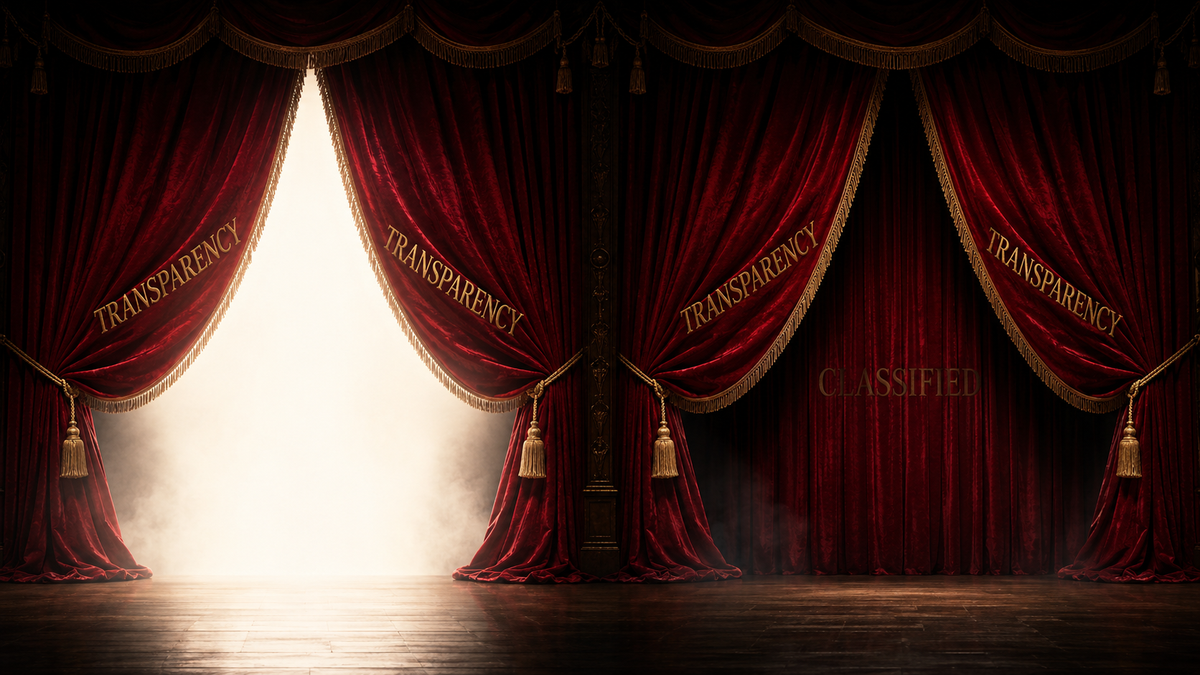
The cleanest cover-up is one that looks like transparency. You move the conversation from "does this exist" to "what is it" — and you control both the evidence and the answer.
The Independent Review Board Problem
The Burlison amendment, passed by the House in July 2026, establishes an independent UAP Records Review Board to oversee what gets released from the permanent UAP Records Collection at the National Archives. This is legislated independence — a board specifically designed to exist outside direct agency control. On paper, this is exactly what disclosure advocates have demanded. In practice, the board's composition, authority, and classification override powers have not yet been fully defined. Historical precedent from analogous review processes — the JFK Records Review Board, for example — suggests that "independent" review boards consistently encounter agency resistance, classification disputes, and material that arrives redacted beyond usefulness. The mechanism exists. Whether it functions as designed is a different question with a different answer, and that answer won't be available for years.
What the Academic Research Says
A 2026 study published in a peer-reviewed communications journal examined how the current wave of disclosure has affected UAP communities online. It found something the researchers called the "transparency effect" — the release of official documents, rather than resolving debate, has intensified and fragmented it. Communities that previously agreed on basic facts about specific incidents now disagree more, not less, after official documentation became available. The researchers concluded that official transparency had functioned primarily to destabilize consensus, not to build it. Whether this was an intended outcome or a side effect is a question the study does not answer. It is, however, consistent with what a managed narrative would produce.
The Argument Against This Argument
To be precise about what this is and isn't: there is no proof that current UAP disclosure is a deliberate intelligence operation. What exists is a structural pattern consistent with one — agencies that have historically used disclosure as a tool now doing disclosure, in ways that continue to serve their institutional interests. That is suspicious. It is not evidence. The counterargument is straightforward: government agencies are bureaucratic, slow, defensive, and bad at releasing information cleanly — and the disclosure we're getting looks exactly like what you'd expect from institutions that are genuinely trying to comply with congressional pressure while protecting sources, methods, and classified infrastructure. Both explanations fit the evidence. Neither can be ruled out from the outside.
What can be said is this: the intelligence community has done this before, the current releases are structured in ways that consistently benefit the agencies producing them, and the independent oversight mechanism is new enough that it has not yet been tested against serious agency resistance. Healthy skepticism about the process does not require believing in a conspiracy. It only requires remembering what these institutions have demonstrably done in the past when the interests of public knowledge and institutional protection came into conflict.
The files are open. The question in Part 3 is what would have to be true for us to know the difference between disclosure and its imitation — and whether that difference is knowable at all.
— The Signal
Next in The Disclosure Game: What would real disclosure actually look like — and how would you know if you were getting it?
Sources:
- NewsNation — UFO researcher suggests disclosure push may be latest coverup
- Taylor & Francis — Between Disclosure and Conspiracy: The Transparency Effect on UAP Communities
- New Space Economy — What Does UAP Knowledge in 2026 Actually Show?
- Rep. Burlison — House Adopts UAP Disclosure Framework Amendment
- Signal Theory — The UFO Community Is Being Played
- Wikipedia — United States UFO Files
Continue the series
- Redacted — The Disclosure Game Part 1 The UFO Files Are Open. They Just Don't Say Anything.
- Redacted — The Disclosure Game Part 3 What Would Real Disclosure Actually Look Like?
- Redacted The FOIA Request That Worked, and the Ninety-Nine That Didn't