The FOIA Request That Worked, and the Ninety-Nine That Didn't

Transparency isn't a right you have. It's a request you file, and then wait, and then maybe lose.
The FOIA Request That Worked, and the Ninety-Nine That Didn't

Redacted

Transparency isn't a right you have. It's a request you file, and then wait, and then maybe lose.

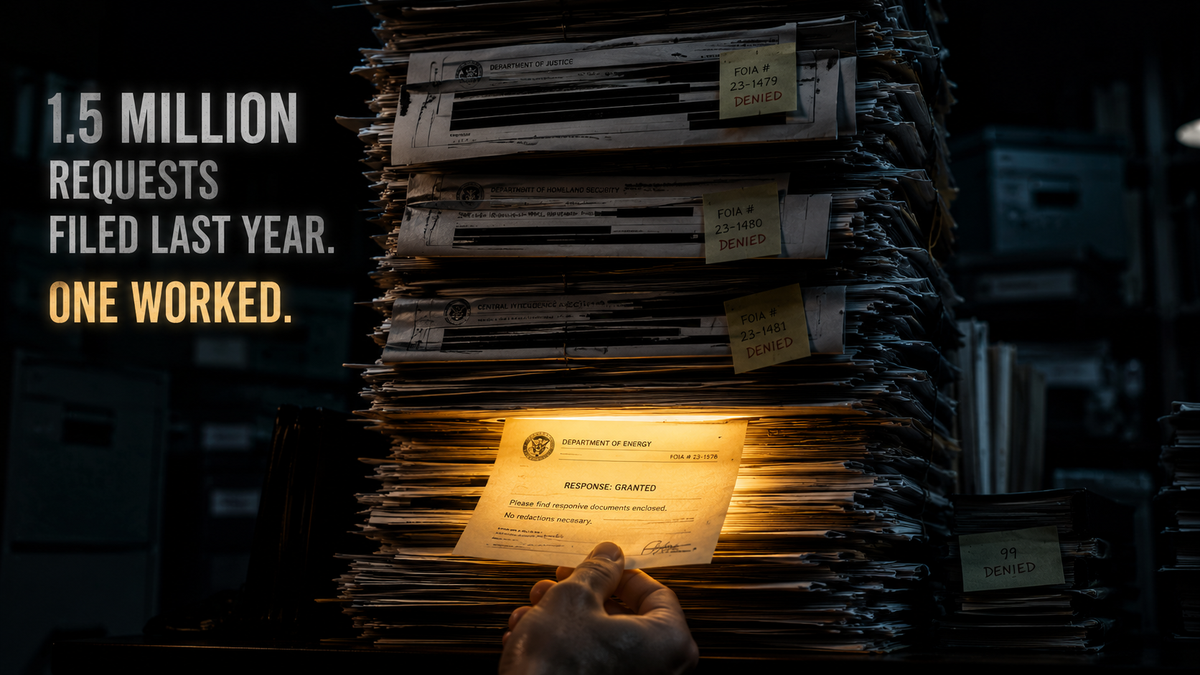
Here's a number worth sitting with: federal Freedom of Information Act requests have nearly doubled over the past five years, climbing to roughly 1.5 million in a single recent year. Here's the number that should sit right alongside it, and doesn't get nearly as much attention: the number of federal FOIA officers processing those requests hasn't meaningfully grown at all in that same span. Demand for transparency went up. The institutional capacity — or willingness — to deliver it stayed flat. That gap is not an accident of bureaucratic understaffing. It's a policy outcome, even if no one ever signed a memo calling it that.

What "Denied" Actually Looks Like

The myth of FOIA, the one most people carry around without ever testing it, is that it's a clean mechanism: you ask, the government has a legal obligation to answer, and within a defined window you get your documents, redacted where genuinely necessary, intact everywhere else. The reality, according to the organizations that file these requests for a living, is a lot messier and a lot more discretionary than that. One transparency organization's review of its own requests over a five-month period found that of the ones that had actually been resolved — not still sitting in review limbo — roughly 10% had their fee waivers denied outright, and another 20% were marked merely "conditional," a designation that can functionally stall a request indefinitely without ever issuing a clean denial someone could appeal.

A request that's neither approved nor denied, just permanently "under review," isn't transparency. It's a polite, paperwork-shaped way of saying no without having to put "no" in writing.

Two agencies accounted for a wildly disproportionate share of those outcomes in that particular review — one for more than half of the outright fee-waiver denials, another for more than half of the "conditional" stalls. That's not randomness. That's a pattern specific enough to suggest certain institutions have simply gotten more comfortable than others treating the legal obligation to disclose as a target to manage downward, rather than a rule to follow.

The Quiet Tools of Slow-Walking a Request

Outright denial is actually the least common way a FOIA request gets neutralized, because outright denial creates a paper trail that can be appealed, litigated, and reported on. Far more common, and far harder to fight, are the slower tools: delay past any reasonable processing window, with no real penalty for the agency that misses it; fee structures that quietly price out smaller outlets and individual requesters who can't absorb thousands of dollars in processing costs while waiting months for an answer; "conditional" statuses that keep a request technically alive while ensuring it never actually resolves; and scope negotiations that whittle an ambitious request down, clarification by clarification, until what eventually arrives bears little resemblance to what was originally asked for.

None of these tools require an agency to ever say the word "no." That's precisely what makes them effective. A denial is visible, countable, appealable. A request still pending eighteen months later, quietly, with no urgency on either end, simply disappears from the public conversation the requester was trying to inform.

When It Actually Works

And yet — it does, sometimes, work, which is exactly why it's worth understanding the mechanism rather than dismissing the whole system as theater. The roughly 20,000 MKUltra-related documents that survived the CIA's 1973 destruction order resurfaced specifically because of a FOIA request filed in the years after, one that happened to land while congressional pressure on the program was already mounting. The recent wave of UAP declassifications happened because sustained, public, bipartisan congressional pressure made continued stonewalling more politically costly than disclosure. In both cases, the request itself wasn't sufficient on its own. It worked because it was paired with external pressure loud enough, and sustained enough, that quietly losing the request in the queue stopped being the cheaper option.

That's the actual mechanism worth understanding, and it's less romantic than "transparency wins because the law demands it." The law creates the opening. Pressure — journalists, advocacy groups, members of Congress willing to make noise, sometimes just dumb luck in the timing — is what actually walks through it.

What This Means If You're Not a Journalist

You don't need to be an investigative reporter to use this system, but it's worth knowing the deck before you sit down at the table. A single, isolated request, filed politely and left to the normal queue, faces real odds of delay, fee friction, or quiet non-resolution — not necessarily malice, but a system with far more demand than capacity and very little incentive to prioritize a request nobody's watching. A request filed alongside public attention, a clear deadline, and a willingness to follow up loudly and repeatedly behaves very differently. The law is the same in both cases. The outcome rarely is.


So: the next time an agency tells you something is "still under review" — is that actually still in progress, or is it sitting exactly where it would sit if nobody outside that office was paying close enough attention to make it expensive to ignore?

Sourcing

Subscribe now — make a bold move