The Future Is Already Here — and It Says It Understands
I went looking for hand cream. I found the machinery underneath everything. A company built on care deployed undisclosed AI to perform it — and only revealed the truth when pressed.
It started, as many of the best investigative discoveries do, with extremely dry hands and a grudge.
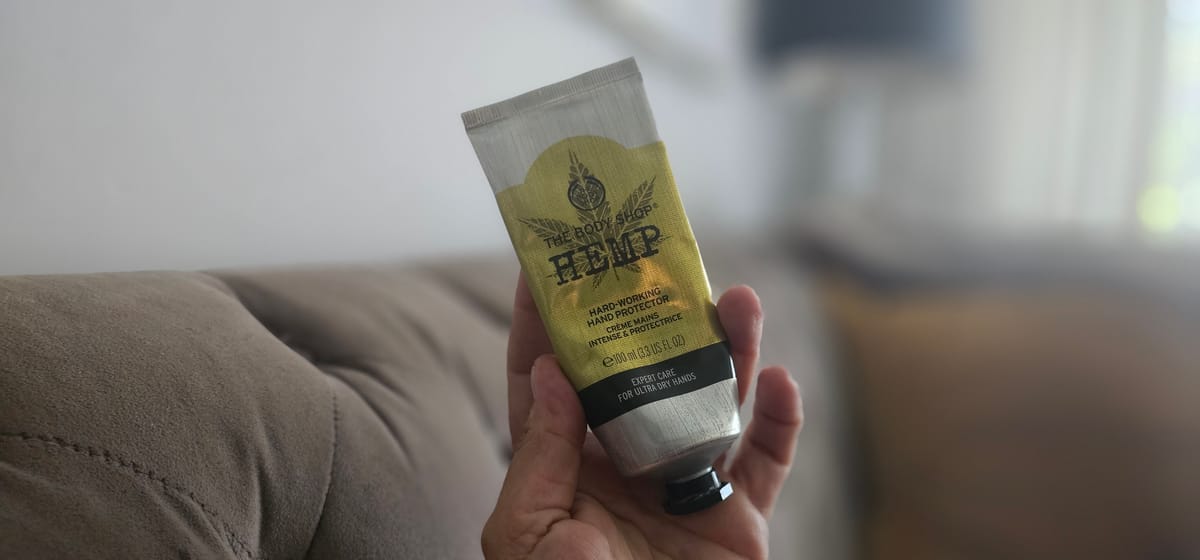
I have been using The Body Shop Hemp Hand Protector for years. Years. The kind of loyalty that involves rationing the last half-tube, buying duplicates when they go on sale, and — I will say this without shame — sourcing old stock on eBay. It was the good stuff: thick, waxy, smelled faintly of earth and hemp, and actually worked on the kind of dry that lotion laughs at. A cult product. Deserving of the cult.
Then they reformulated it.
The new version smells like a candle store and absorbs in four seconds, which sounds like a feature until you realize that means it is not doing anything. It is, essentially, expensive-smelling water. The old Hemp Hand Protector stayed on your hands. It formed a barrier. It treated your skin like a problem worth solving rather than a surface to briefly acknowledge before moving on.
So I did what any reasonable person does when a company ruins something they love: I contacted customer support to register my disappointment in formal written terms, as though that has ever once changed anything but has always felt momentarily satisfying.
The Empathy Machine
The response came quickly. Too quickly, in retrospect, but I was not yet suspicious. The Body Shop Canada Customer Support Team — that was how it signed off — expressed that they completely understood my disappointment. They said my feedback was greatly appreciated and very detailed. They said they were sorry to hear the reformulation had not met my expectations.
I wrote back with more detail. They responded again: warm, personal, empathetic. They completely understood. My loyalty meant so much to the brand. They would note my specific concerns.
Reader, I was moved. I felt heard. I felt like maybe corporate customer service had turned a corner.
I asked them to please forward my concerns to the Canadian product team so that the people who actually make the decisions about the formula might know that a real person with real dry hands was unhappy about them.
The reply came. And this is where it got interesting.
“This is not something I am able to do from here. Your concern will now be passed to a human team member.”
Pause.
A human team member.
Which raises a question so obvious it should not need to be asked: if my concern was being passed to a human team member now, then who exactly had I been talking to this entire time?
Spoiler: Not a Human
The machine had been doing what machines trained on customer service interactions do with remarkable, eerie competence: saying “I completely understand” and “your feedback is appreciated” and “I’m sorry to hear this” in exactly the cadence a human support agent would, while being functionally incapable of understanding anything, appreciating anything, or being sorry about anything.
It could not forward feedback. It could not contact a department. It could not create a note that a human would actually read. It could simulate concern while being structurally incapable of acting on concern — which, if you think about it, is a fairly good description of a lot of corporate customer service, except that the underpaid human on the other end at least has the theoretical capacity to feel bad about it.
The machine felt nothing. It just said it did. Repeatedly. Convincingly. While signing as “The Body Shop Canada Customer Support Team.” Not “The Body Shop Canada Automated Response System.” Not “Hi, I’m an AI assistant.” Just the team. As though a team existed. As though you were writing to people.
Then the Human Team Member Responded
A day later, a response arrived. From a human team member, presumably. It was warm. Personal. Empathetic. It said my feedback had been passed to the relevant team. It said they were working on improvements. It said they understood how much the original formula had meant to loyal customers.
I ran it through an AI detector.
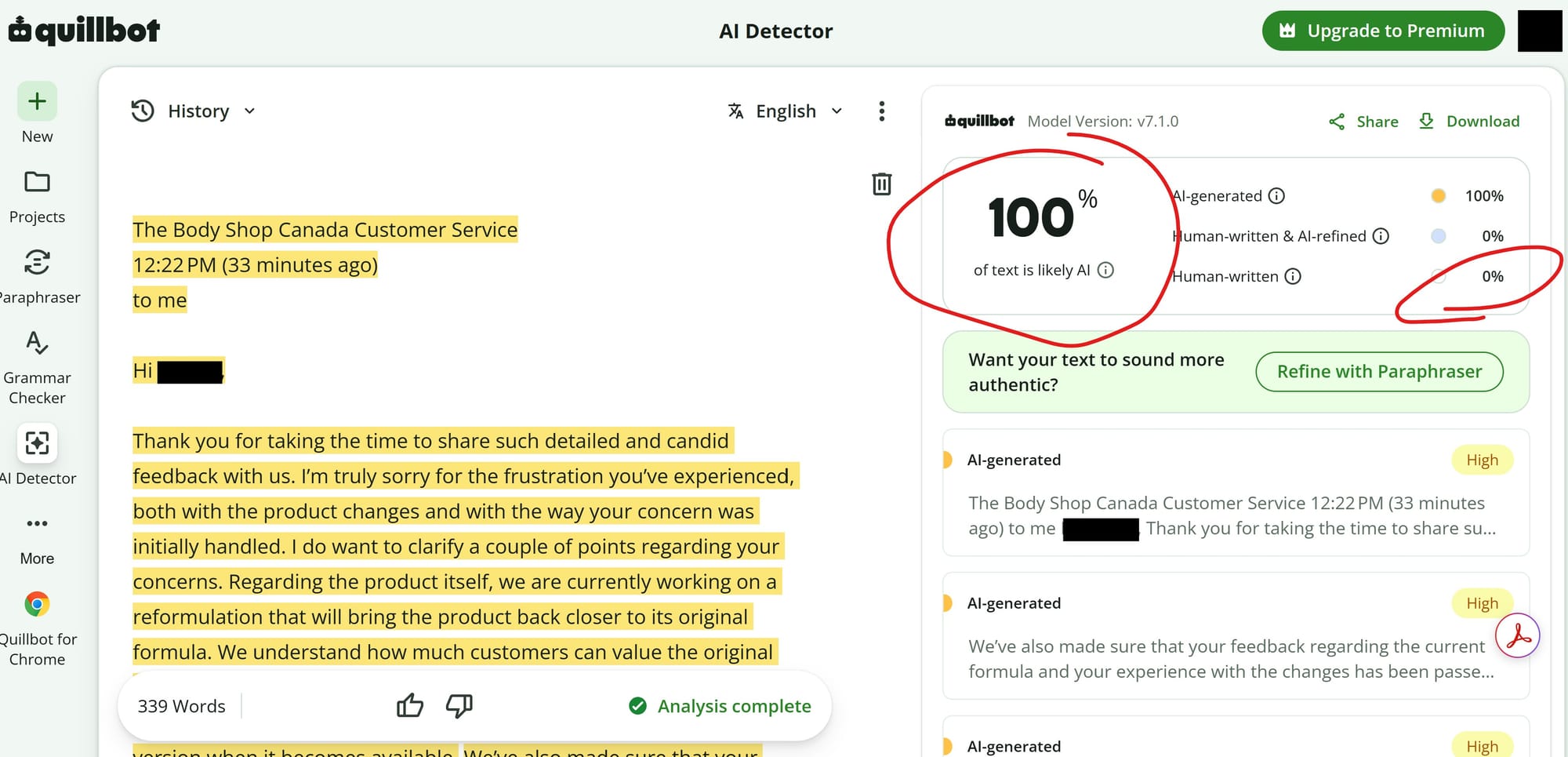
One hundred percent AI-generated. Zero percent human.
The human team member was also a machine.
To recap: I contacted The Body Shop Canada. A machine responded, pretending to be a team. It promised to escalate to a human. A different machine responded, pretending to be that human. At no point did a human being engage with my concern, express actual empathy, or take any meaningful action. At every point, the interface was designed to make me believe otherwise.
It’s not a customer service failure. It’s a customer service theatre production, automated end to end.
The Particular Cruelty of Doing This as The Body Shop
Here is the thing. If McDonald’s had done this, it would be mildly annoying but not especially notable. McDonald’s does not build its brand around the idea of ethical human care. McDonald’s builds its brand around the idea of a clown and speed and fries that are inexplicably perfect every single time.
The Body Shop is a different proposition. Against animal testing when that was a genuinely radical position. For fair trade before it was a label you could slap on a canvas tote bag. Built around the idea that a company could care — actually care — about the people it serves. “Enrich, not exploit” was not just a tagline. It was supposed to be the entire point.
So the choice to deploy not one but two layers of undisclosed AI to perform empathy — to have software pretend to be a support team, then have different software pretend to be the human that team escalated to — is not merely a customer service failure. It is a brand contradiction so complete it deserves its own case study. They built an identity around the idea that care is not just a word. Then they automated the word and removed the care.
Nothing communicates “we don’t care” more effectively than two different machines taking turns saying “I understand” while being completely unable to do anything about what they understand.
The Meta Twist (Because Of Course There Is One)
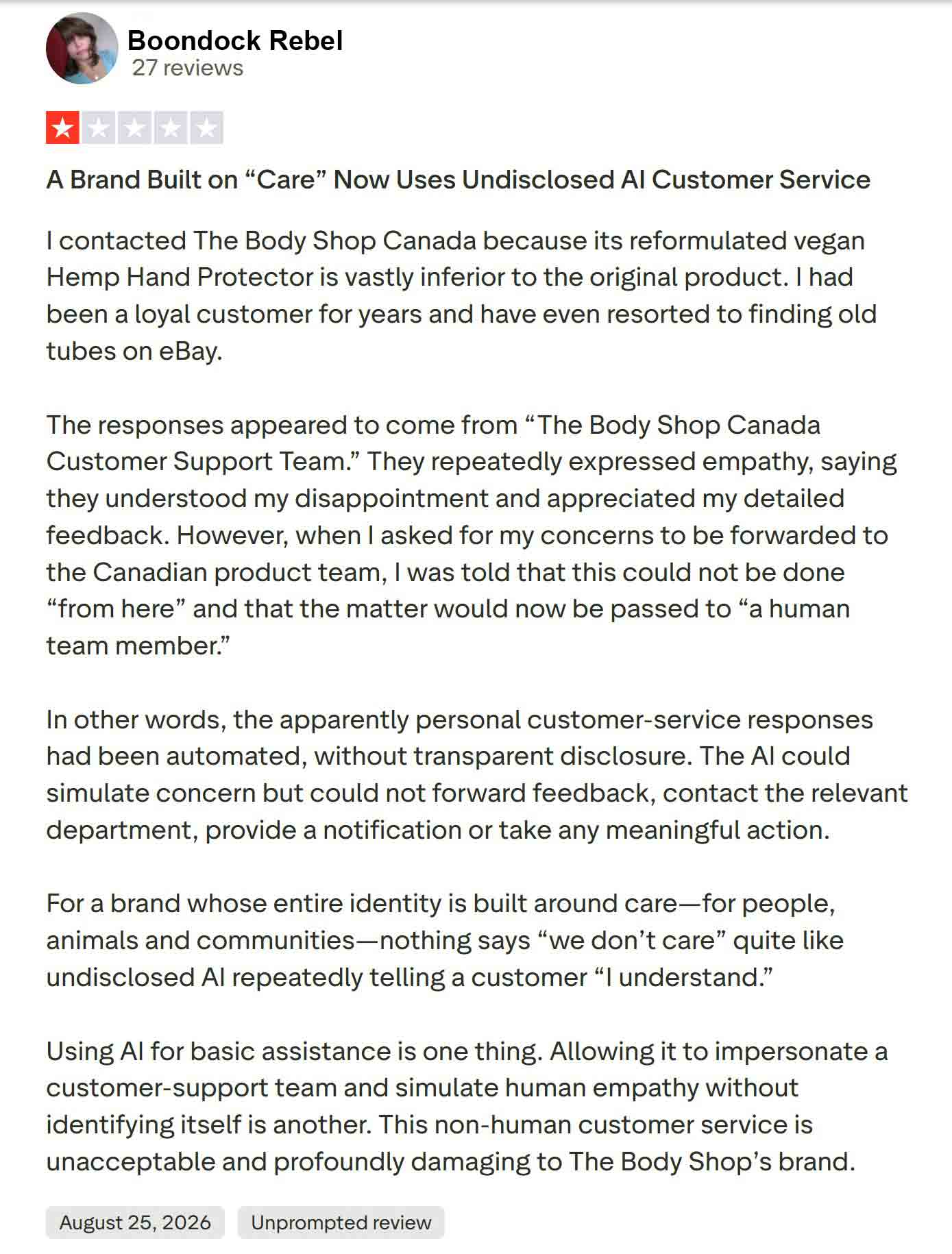
After this experience, I was irritated enough to write a proper Trustpilot review and a formal complaint letter. I was also busy. So I opened a different AI — ChatGPT, specifically — and used it to help me draft both.
I used artificial intelligence to articulate why artificial intelligence impersonating humans is a problem.
I want to be clear that I see this irony. I also want to be clear that it does not undermine the argument. The issue is not AI. The issue is undisclosed AI performing human identity — a system signing as “The Body Shop Canada Customer Support Team” when it is not a team, and a follow-up system signing as a “human team member” when it is not a human.
This Is Happening Everywhere. Most People Don’t Notice.
The Body Shop is not unique in deploying this. They are just uniquely bad at it from a brand-coherence standpoint. Across retail, banking, healthcare, and now apparently the artisanal-ethics beauty sector, the same infrastructure is being installed: AI that responds in the first person, expresses sympathy in the first person, apologises in the first person, and does not identify itself as anything other than a team, a representative, or a person named Sarah.
Most people do not notice because the writing is good now. It mirrors your language, matches your register, references what you said two messages ago. It sounds, with alarming fidelity, like someone paying attention.
The tell is what it cannot do. Human support agents — even spectacularly unhelpful ones — can pick up a phone, send an internal email, flag a ticket. The machine can only generate the next plausible response. And when it reaches something outside its parameters, it passes you to another machine that pretends to be the human who can.
That moment — “I’ll pass this to a human team member” — is the confession. File it. Then run the response through an AI detector.
What You Can Do With This
Ask, at the start of any customer service interaction: “Am I speaking with a human or an AI?” A system that lies in response to that direct question is in considerably murkier legal territory than one that simply never volunteers the information.
Run suspicious responses through an AI detector. It takes thirty seconds and has, in my experience, a 100% success rate.
And if a brand whose identity rests on care assigns two consecutive machines to perform care at you without disclosing what they are — tell people. Publicly. The pattern only becomes visible when enough people start naming it.
The future is not arriving. It arrived. It has been in your inbox. It has been performing care with the competence of a skilled actor and the accountability of a server farm in an undisclosed location.
It cannot forward your concern. It cannot contact the relevant team. It cannot do anything, in the end, with what it so thoroughly, repeatedly, warmly understands.
But it will pass you to a human team member now.
A different machine. Just as warm. Equally unable to help.
Have you had a similar experience? Undisclosed AI performing as a human customer service team? Name it publicly. The pattern only becomes visible when enough people start pointing at it.