
We Built the World That Made Him Possible
34 felony counts. A $364M fraud penalty. Found liable for sexual abuse. None of it stuck. This isn't a mystery about one man — it's a mirror held up to the culture that built the mechanism he's running on.
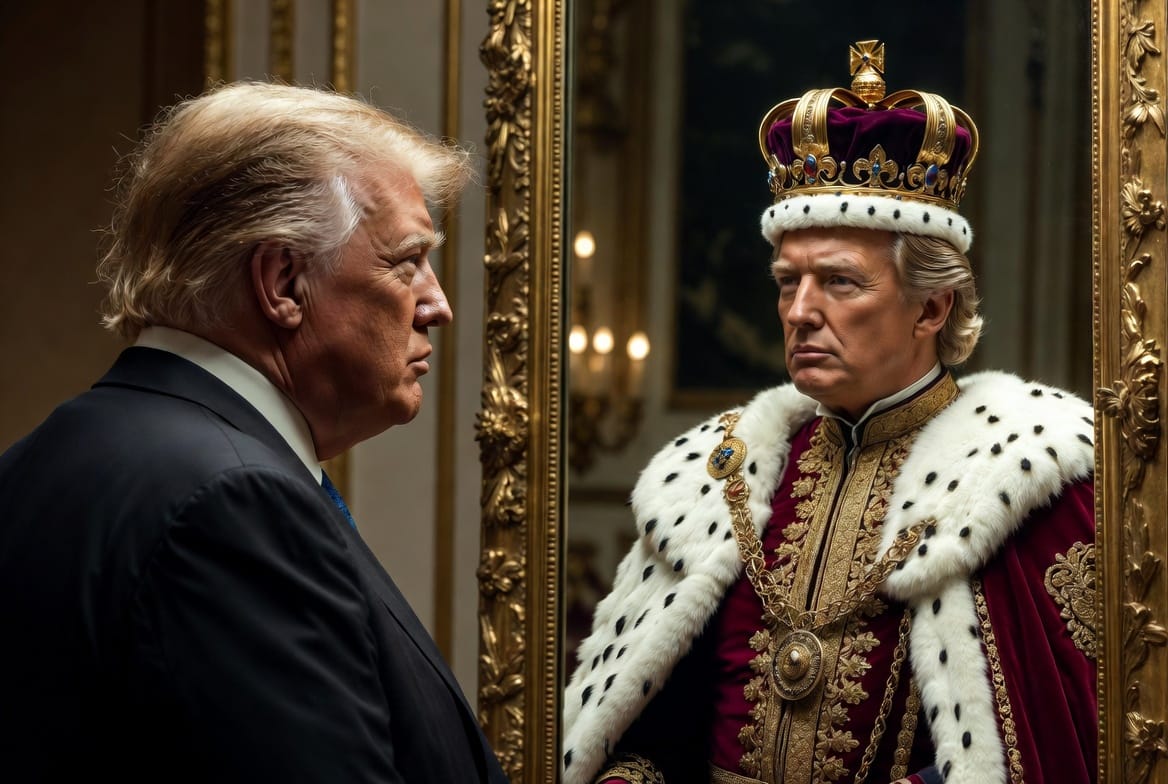
A jury found him liable for sexual abuse. Another awarded $83.3 million in defamation damages. A judge imposed a $364 million fraud penalty. A criminal jury returned 34 felony counts. None of it has mattered in the way that accountability is supposed to matter. This is not a mystery about one person. It's a mirror held up to the culture that built the mechanism he's running on.
The record is not disputed. In May 2023, a New York jury found Donald Trump liable for sexual abuse and defamation against writer E. Jean Carroll, awarding $5 million in damages. In January 2024, a different jury awarded Carroll an additional $83.3 million in defamation damages after Trump continued to publicly deny what the first jury had established. In February 2024, Judge Arthur Engoron imposed a $364 million penalty in the New York civil fraud case, finding that Trump and his organization had engaged in persistent and significant financial fraud over many years. In May 2024, a Manhattan criminal jury returned guilty verdicts on all 34 counts in the hush money case, making Trump the first former US president convicted of felony crimes. In the appeals court rulings since, Trump has continued to lose on the Carroll judgments. The legal record, as a factual matter, is not a gray area.
And yet. The mechanism that should translate this record into political and social consequence — the accountability mechanism that operates on the premise that verified wrongdoing changes how people evaluate a person — has not operated the way it theoretically should. The question that matters is not about Trump specifically. The question is: what is the culture that produces this? Because this didn't come from nowhere, and it won't end with him.
What Psychology Says About This Pattern
Clinical psychologists describe narcissistic personality disorder as characterized by a specific cluster: grandiosity, a need for admiration, a lack of empathy for the people harmed by one's actions, and — critically — a relationship with truth that treats it as instrumental rather than binding. Not lying as a tactical decision, but lying as a primary mode of self-presentation, where the statement that serves the moment is the statement that gets made, and the relationship between that statement and factual reality is genuinely secondary. The relevant professional community has been largely careful about diagnosing specific public figures — the American Psychiatric Association's Goldwater Rule discourages remote diagnoses — but in 2017, a group of 27 mental health professionals published a book, The Dangerous Case of Donald Trump, arguing that a public duty to warn the public about psychological dangers presented by public figures could override the professional norm. The book was notable not for being a fringe document but for reflecting concern among credentialed clinicians about a pattern that was, in clinical terms, recognizable.
The recognizability is the point. Narcissistic presentation — the confidence that looks like strength, the shamelessness that looks like fearlessness, the refusal to acknowledge error that looks like certainty — is not unfamiliar to most people. It maps onto qualities that culture has, for decades, been training people to recognize as signs of success.
Reality TV Did the Setup Work
The Apprentice aired from 2004 to 2017. For thirteen years, a primetime audience watched a character — not a person, a television character — dispense judgment, project certainty, and be positioned as the arbiter of who had what it takes. The format required a central authority figure whose decisions were portrayed as wise and whose confidence was portrayed as earned. The character played by Trump in that format was not Trump. It was a construction — a persona built by producers, edited for effect, and designed to be compelling television. The audience understood this in the way that television audiences understand fictional things: they knew it was performed, but they also absorbed the thing being performed. Fourteen seasons of a primetime character who never apologized, never expressed doubt, never suffered consequence for being wrong, and was narratively positioned as the smartest person in every room. That is not a neutral cultural input.
The Apprentice didn't create the character. It created the audience that already knew how to receive him when he arrived in the real world wearing the same outfit.
The Instagram Economy Normalized the Rest
The specific mechanism that makes public accountability fail in a media environment shaped by social platforms is not complicated: image has been systematically decoupled from reality, at scale, for long enough that a significant portion of the population has stopped expecting them to match. Instagram filters. Sponsored content labeled in fonts too small to read. Influencers who monetize personal brands built on curated performances of authenticity. Before-and-after photos that are fraudulent. Lifestyle content that is staged. The accumulated effect of fifteen years of consuming media where the gap between presentation and reality is constant, deliberate, and unremarked upon is that the audience develops — necessarily — a different relationship with the gap. When everything is a brand and every brand is a performance, the demand that a specific public figure's performance match his legal record starts to feel like an application of a standard that nothing else in the environment is applying. The person is running the same mechanism that every influencer runs. The scale is different. The mechanism is the same.
What Accountability Actually Requires
Accountability is not a natural property of institutions. It is a mechanism that works when a specific condition is met: the people who have the power to impose consequences on a person believe that factual reality is more authoritative than the narrative that person is constructing. Courts can establish factual reality — and they have, repeatedly, in the legal record described above. But courts work in isolation. The political and social consequences of a court record depend on a public that receives it, weighs it, and adjusts its evaluation of the person accordingly. That process requires a shared commitment to the premise that what a court establishes has authority over what the person being evaluated says about it. In a media environment where the norm is that every claim is contested, every institution is partisan, every fact has a counterfact, and every record has a reframe — the premise that court findings have authority over personal narrative is not reliably shared. That is not an accident. It is what fifteen years of increasingly fragmented, narrative-driven, reality-optional media consumption produces.
The Question Worth Asking
The persistent question about Trump — why doesn't any of this stick — is framed as a question about him. It is more accurately a question about us. What is the culture that produced an environment where the mechanisms that should translate verified wrongdoing into consequence don't function the way they're supposed to? Where the gap between documented reality and personal narrative can be maintained indefinitely without social cost? Where the performance of confidence reads as competence and the performance of fearlessness reads as strength regardless of what the record shows? The answer is not that we have all been fooled. It is that we have been trained, by a media environment we built and chose and feed daily, to relate to the gap between image and reality as normal — as the cost of a media culture we happen to enjoy. The man is not the anomaly. He is what happens when the anomaly is the culture, and someone is sufficiently willing to use it.
The record is real. The verdicts are real. The $83 million is real. The 34 counts are real. What is also real is the media environment that taught us to hold lightly to the relationship between what's documented and what matters. He didn't create that environment. He's just the most extreme user it has ever produced. The question is what we do about the environment, because that's the part that outlasts any individual running on it.
— The Signal
Sources:
- PBS NewsHour — Trump Ordered to Pay $83.3 Million to E. Jean Carroll
- PBS NewsHour — Judge Imposes $364 Million Penalty in Trump's New York Civil Fraud Case
- NPR — E. Jean Carroll Receives $5.6 Million in Damages from Trump
- Bandy X. Lee, MD — The Dangerous Case of Donald Trump: 27 Psychiatrists Assess
