What If the Placebo Effect Is the Point?

Belief alone produces measurable, neurobiologically real healing responses. The pharmaceutical industry has spent decades treating this as a problem to control for. Maybe it's the most important thing they've found.
What If the Placebo Effect Is the Point?

Stories from the Edge

Belief alone produces measurable, neurobiologically real healing responses. The pharmaceutical industry has spent decades treating this as a problem to control for. Maybe it's the most important thing they've found.

Every clinical drug trial uses a placebo control. The purpose is to isolate the drug's effect from the effect of simply believing you're being treated. The logic is that the belief response is noise — something to subtract out, a confound that interferes with measuring the real thing. This framing has produced an enormous amount of useful pharmacological data. It has also, arguably, led the entire field to spend a century studying the wrong variable.

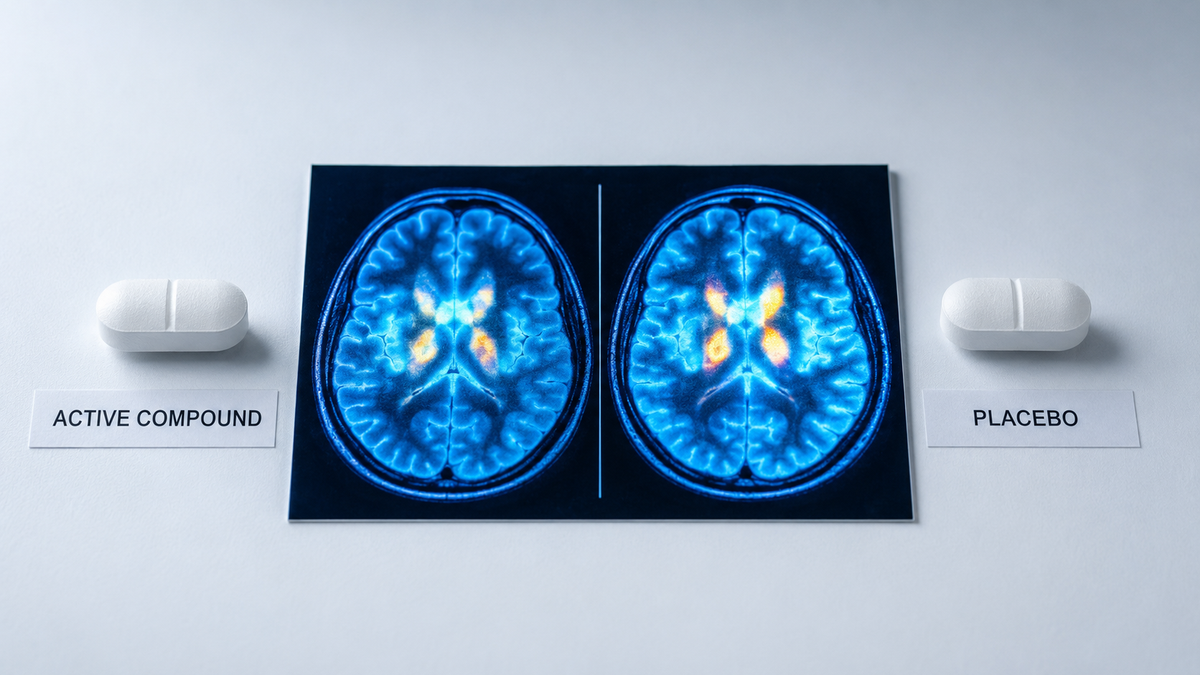
The placebo effect — the measurable physiological improvement that occurs in patients who receive an inert treatment while believing it to be active — is not small. Research published in the New England Journal of Medicine has documented real neurobiological mechanisms: placebo interventions modulate neurotransmitter activity, produce demonstrable changes in brain imaging, and in some conditions generate outcomes that rival active drug treatment. The effect is not imaginary. It is not statistical error. It is the body doing something real, in response to an expectation that something real is being done to it. And the question that the research has not adequately answered, because it has not been organized around asking it, is: if the body can do that — if it can produce meaningful healing in response to structured belief — why is the primary clinical interest in suppressing the signal rather than amplifying it?

What the Research Actually Shows

A 2025 narrative review in PubMed synthesizing decades of placebo research found that placebo effects produce genuine biopsychosocial changes — not just reported symptom improvement, but measurable neurobiological activity. Sham surgeries outperform real surgeries for certain pain conditions in controlled trials. Open-label placebos — where patients are told they're receiving an inert pill and experience improvement anyway — have shown effects in irritable bowel syndrome and cancer-related fatigue. The effect is not, as is sometimes claimed, dependent on deception. Some of it operates through pathways that function even when the patient knows the mechanism.

The nocebo effect — the inverse — confirms the mechanism from the other direction: patients who are told a treatment will cause side effects report those side effects at significantly higher rates, including measurable physiological changes, even when the treatment itself is inert. The expectation produces the biology. Both directions, consistent, replicated.

The Thing the Industry Has Gotten Very Good at Ignoring

The pharmaceutical industry's clinical trial framework is designed to subtract the placebo effect from the drug effect. Regulators require it. The logic is that you want to know what the drug does independently of what the patient believes. This is reasonable from a specific vantage point: if you're trying to identify a molecule's mechanism of action, you need to separate it from the belief response. But if you're trying to optimize patient outcomes — which is ostensibly the purpose of medicine — then a treatment effect that is real, reproducible, neurobiologically grounded, and producible without a molecule at all is not noise. It is a finding. A significant one. It is just a finding that generates no patent, no proprietary compound, no revenue stream, and no research funding from entities whose business model requires a billable molecule.

The placebo effect is the most replicated finding in the history of medicine. It is also the finding most systematically organized to be studied as an obstacle rather than a resource.

The Therapeutic Relationship as Active Ingredient

Research on what predicts placebo response has consistently found that the quality of the patient-clinician relationship is among the most powerful variables. Patients who feel heard, believed, and cared for by their providers show larger placebo responses than patients who feel processed. Warmth, attention, and ritual — the components of a good bedside manner — are, in the neurobiological language the research now supports, active treatment components. They change outcomes through real mechanisms. A healthcare system optimized for throughput and efficiency, in which appointments are seven minutes and documentation is electronic and the interaction is transactional, is not just failing patients emotionally. It is, in a measurable and documented way, failing to deploy one of the most powerful treatment mechanisms available.

What Belief-Based Healing Would Require Us to Accept

This is the uncomfortable part. If belief produces real healing through real neurobiological pathways, the implication is that the mind-body connection is not metaphor — it is mechanism. That thought patterns, expectations, and the perceived quality of care alter physiology in ways that matter for disease outcomes. This is not a claim about consciousness or spirituality. It is a claim about neuroscience. The research supports it. The framework of mainstream medicine is not organized to act on it, because acting on it would require the system to value and invest in things — therapeutic relationships, ritual, expectation management, patient-clinician connection — that do not fit neatly into a billing code or a proprietary treatment protocol.


The body can heal in response to a structured expectation of healing. That has been demonstrated. What has not been organized is a healthcare system that treats this as the resource it is, rather than the confound it inconveniently keeps being.

— The Signal

Sources:

KEEP GOING →

Dark Matter Doesn't Exist (and That's the Problem)

For decades, physicists have been searching underground for a particle that should be everywhere. They have found nothin

You might also like