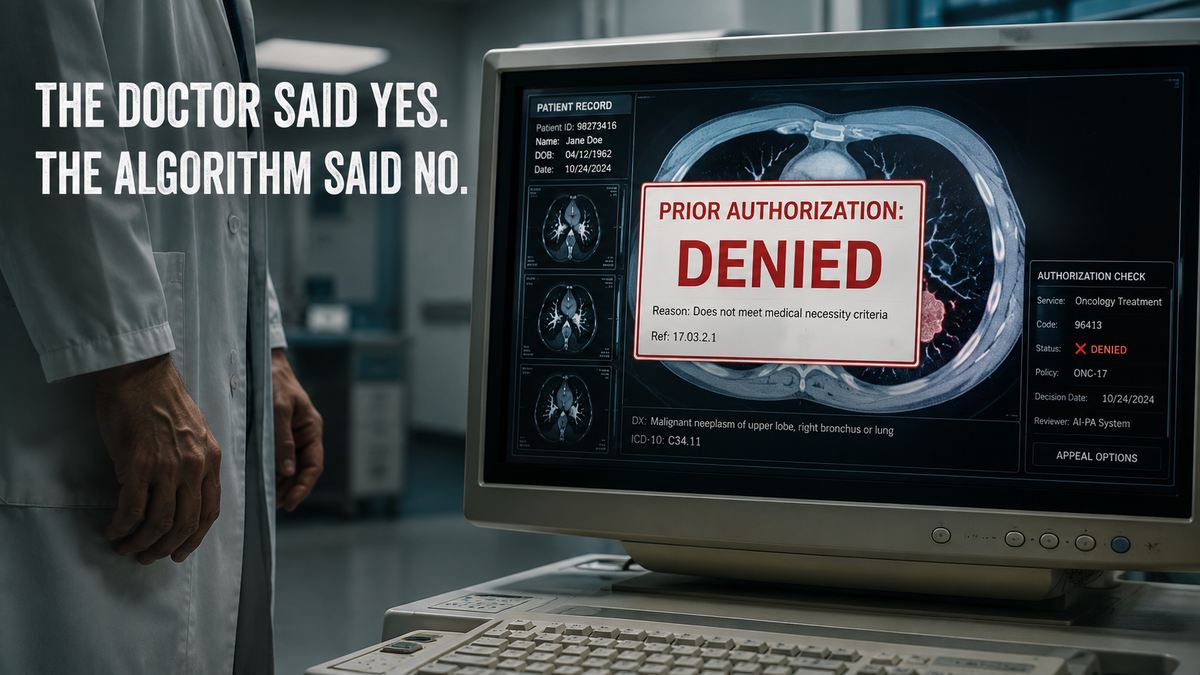
The Algorithm That Decides Whether Your Cancer Treatment Gets Approved

You've never heard of the company quietly saying no to your doctor. That's by design.

The Algorithm That Decides Whether Your Cancer Treatment Gets Approved

The Underdog Files

You've never heard of the company quietly saying no to your doctor. That's by design.

You think your insurance company is the one deciding whether your treatment gets covered. Often, it isn't. A separate company, one most patients have never heard of and most doctors only know as a source of paperwork hell, sits between your physician's recommendation and your actual care — reviewing the request, running it against internal criteria, and frequently saying no, on behalf of an insurer that gets to keep its own name out of the conversation entirely.

One of the largest players in this space handles prior-authorization decisions for major American health insurers, touching coverage for roughly 1 in 3 insured people in the country. That is not a fringe player. That is a quiet, massive piece of infrastructure sitting directly between you and your doctor's medical judgment, and almost nobody outside the industry can name it.

The Business Model, Stated Plainly

Here's the part that should make you sit up: this is not an incidental side effect of a company trying to manage costs responsibly. According to reporting on the industry, sales representatives for one such denial-management company have touted, as a selling point to insurers, the ability to increase denial rates by double digits. Read that as what it actually is — a service sold on its capacity to say no more often, marketed the way you'd market any other efficiency gain, except the "efficiency" in question is a person's chemotherapy, a scan, a medication that keeps a chronic condition from spiraling.

Somewhere, a sales deck quantified your denial as a performance metric, and someone closed the deal.

This is the unglamorous reality behind a phrase you've probably heard a hundred times without ever interrogating it: "prior authorization." It sounds like paperwork. It functions, in practice, as a second, largely invisible layer of medical decision-making, conducted by reviewers who have never examined the patient, weighing criteria that prioritize cost containment, working from a position where every approval is a cost and every denial is a savings the contracting insurer gets to claim credit for.

Your Doctor Isn't the One Saying No

This is the detail that breaks the mental model most patients walk in with. You assume that if your doctor recommends a treatment, the fight — if there is one — is between you and your insurance company, a recognizable entity with a name on your card and a customer service line you can call. In reality, a meaningful share of that fight is happening one level removed, with a third-party reviewer whose entire commercial relationship is with the insurer, not with you, and whose performance is measured, at least in part, by how often that reviewer says no.

Doctors describe the resulting workflow as a kind of low-grade, permanent administrative siege: forms, appeals, peer-to-peer calls scheduled and rescheduled, denials issued and then sometimes quietly reversed only after a doctor personally argues the case to another doctor employed by the review company — a doctor who, by the structure of the arrangement, was never going to see the patient and never has to live with the consequences of getting it wrong.

Who Actually Absorbs the Delay

Every layer of friction in this system gets absorbed by someone, and it is reliably not the company that built the friction. The patient absorbs it as a treatment delayed weeks or months past when it was medically indicated. The doctor absorbs it as uncompensated administrative labor, hours spent fighting decisions instead of treating patients. The insurer, notably, does not absorb it — the insurer gets to point to a third party's decision as the source of the denial, while still benefiting financially from a system engineered to deny more.

This arrangement is not an accident of healthcare being "complicated." It is a deliberately constructed division of labor: one company keeps its name on the card you carry and its reputation relatively clean, while a different, less visible company does the actual saying-no, takes the reputational hit nobody outside the industry even knows to direct at it, and gets paid for volume.

The Appeal That Works, and the Hundred That Don't

Here's the genuinely useful, infuriating fact buried in all of this: a meaningful share of these denials get overturned on appeal — which tells you something important about how many of the initial denials were never medically justified to begin with. The system isn't designed to be unbeatable. It's designed to be exhausting enough that a large share of patients and doctors simply don't have the time, energy, or administrative stamina to fight every single no. Attrition, not medical judgment, is doing a lot of the actual cost-saving here. The treatment that should have been approved the first time gets approved eventually, for the people who had the capacity to keep pushing — and quietly drops off the list for the people who didn't.


So: if a meaningful share of denials get reversed on appeal, how many of the ones that never got appealed — because the patient was too sick, too broke, or too exhausted to fight — were just as wrong, and simply never corrected?

Subscribe now — make a bold move