Your Mouse Movements Are Training Someone Else's AI, and Nobody Asked You
Every click, pause, and keystroke is now a data point in someone else's product roadmap.
The Underdog Files
Every click, pause, and keystroke is now a data point in someone else's product roadmap.
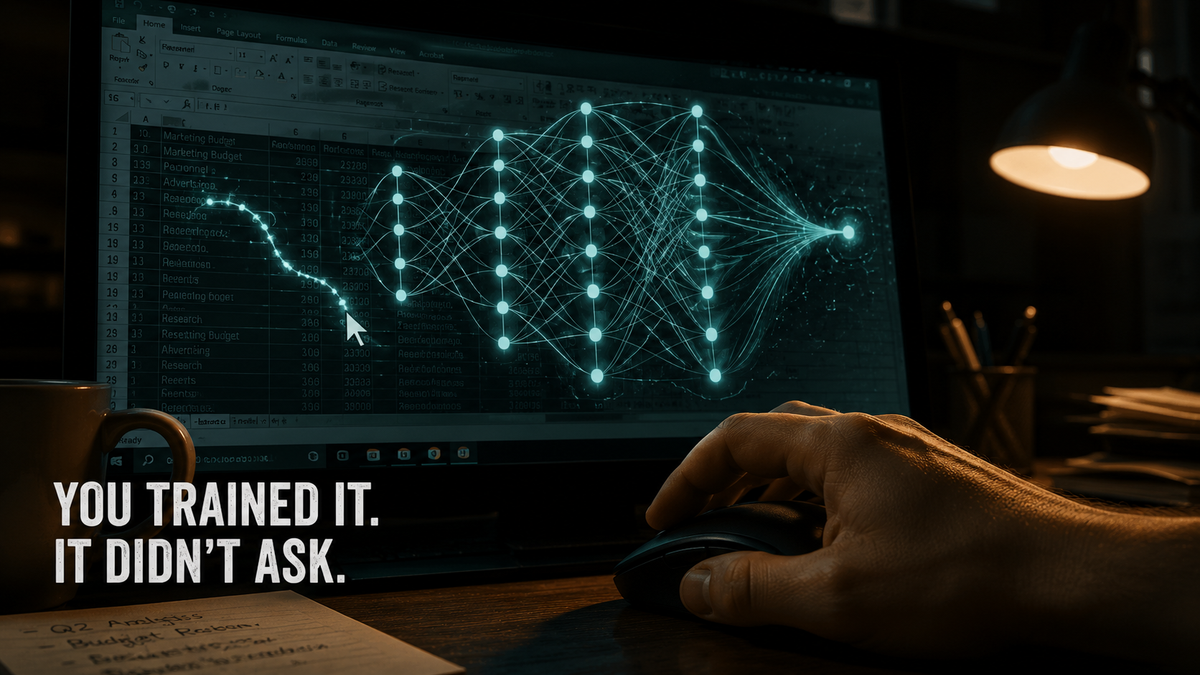
Somewhere between "we monitor productivity" and "we monitor everything," workplace surveillance crossed a line most employees haven't been told about: it's not just watching you anymore. It's teaching a machine to become you. Reporting on internal systems at one of the world's largest tech employers describes testing that tracks mouse movements, clicks, and keystrokes specifically to train AI models on how employees actually navigate software, click by click, pause by pause — feeding your literal muscle memory into a system being built, eventually, to need fewer employees doing exactly what you're doing right now.
The Quiet Upgrade From "Monitoring" to "Training Data"
Workplace monitoring used to have a relatively narrow, almost old-fashioned purpose: catch the person who's slacking, confirm the remote worker is actually working, generate a productivity score for a performance review. Invasive, often resented, but bounded — the data served a specific, human-facing decision. What's happening now is a different category of extraction entirely. Your navigation patterns, your shortcut habits, the specific sequence of clicks you've developed over years of doing your job well, are being captured not to evaluate you, but to replicate the underlying competence itself into a system that doesn't need a salary, a lunch break, or a reason to stay employed past the training period.
You spent years getting efficient at your job. That efficiency just became the product, and you weren't on the list of people who get paid for it.
This is worth sitting with as its own category of harm, separate from the older privacy complaints about workplace monitoring. Being watched is uncomfortable. Being quietly mined as the raw material for your own eventual replacement is a different, colder thing, and it's happening under the same vague banner — "improving our tools," "understanding workflows" — that used to just mean a slightly annoying productivity dashboard.
The Scale Nobody Voted On
This isn't a fringe practice at one unusually aggressive company. Workplace digital monitoring among large employers has expanded dramatically in just a few years — from roughly 30% of large employers using some form of remote-worker monitoring before the pandemic to over 70% now, a jump driven directly by how cheap and easy AI-powered monitoring tools have become to deploy. Regulators have started to notice: U.S. agencies have begun pushing back specifically against "black box" algorithmic monitoring systems that employees can't see inside or meaningfully contest, treating the practice as enough of a consumer and worker protection issue to warrant formal guidance.
The Consent That Was Never Actually Asked For
Here's the structural sleight of hand running underneath almost all of this: employment contracts typically include broad, vaguely worded language about monitoring "for security and quality purposes," signed by employees who had no realistic way to negotiate it and no specific knowledge that "quality purposes" would eventually include "training the system that may replace this exact role." Consent obtained for one stated purpose is being quietly extended, retroactively, to cover a purpose nobody disclosed at the time and most employees would have objected to if asked directly. That's not really consent in any meaningful sense. It's a blank check cashed years after it was signed, for an amount the signer was never told about.
What This Does to How People Work
There's a second-order effect here worth naming, beyond the data extraction itself: knowing your literal keystrokes are being captured to train a replacement changes how people work, in ways that don't show up on any dashboard. Workers describe a creeping reluctance to develop or share genuinely efficient shortcuts and workarounds — the very expertise that used to make someone valuable now reads as a liability, a thing to be quietly withheld rather than demonstrated, once it's clear that demonstrating it well is the fastest way to make it obsolete. A system built to extract competence is, slowly, teaching the competent people to stop showing it.
Who's Actually Accountable for the Outcome
When the resulting AI tool eventually reduces headcount in the department it was trained on, the accountability for that outcome will be diffused across exactly the actors who benefit from it being diffused: the AI vendor will say it built a general-purpose tool, the company will say it's responding to market efficiency, and no single decision-maker will be identifiable as the one who decided your specific work was the raw material for your own redundancy. That diffusion isn't an accident of complexity. It's the most useful feature of the entire arrangement, for everyone except the person whose mouse movements got harvested.
So: if the tool trained on your work eventually does your job without you, who exactly do you hold responsible — and does it change anything that the answer was designed, from the very first line of monitoring code, to be nobody in particular?